ຂປລ
The Government of the Lao PDR and two project developers have signed a Project Development Agreement (PDA) for the proposed 1,275-megawatt (MW) Vilatsaphone Wind Power Project in Savannakhet Province, marking a further step towards developing the country's renewable energy sector.
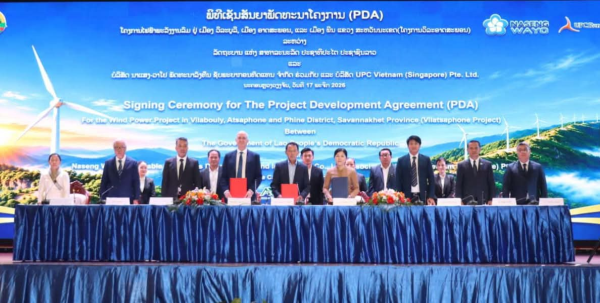
(KPL) The agreement was signed in Vientiane on November 17, 2026, by the government and representatives of Nasengvayo Renewable Energy Investment and Development Co., Ltd. and UPC Vietnam (Singapore) Pte. Ltd.
The ceremony was attended by Ms. Phonevanh Outhavong, Vice President of the Investment Promotion and Management Committee, along with representatives of the National Assembly, government ministries, committees, departments and other relevant stakeholders.
Mr. Khamsavath Bounvilay, Director of Nasengvayo Renewable Energy Investment and Development Co., Ltd., said the agreement builds on a Memorandum of Understanding (MOU) signed on November 13, 2023. It establishes a 24-month framework for the developers to conduct studies and prepare the project for further investment decisions.
The proposed study area covers Vilabouly, Atsaphone and Phine districts, with a planned installed capacity of approximately 1,275 MW. The final project scale and locations will depend on wind resource assessments, site conditions, environmental and social requirements, and the capacity of the electricity grid to accommodate and distribute the power.
The project aims to harness Savannakhet's wind resources to generate clean electricity for regional markets, strengthen cross-border energy cooperation and create potential export revenue for Laos.
It is also expected to create employment, increase demand for local goods and services and contribute to state revenue, subject to the project's successful development and implementation.
Mr. Andrew Sutherland, Managing Director of UPC Vietnam (Singapore) Pte. Ltd., said the project could strengthen Laos' energy security by supplying reliable, domestically generated renewable electricity to the national grid, while supporting the country's ambition to become the "Green Battery of Southeast Asia."
He said the project represents a significant long-term foreign direct investment, with royalties and tax payments expected to contribute to the national budget over a 25-year period.
For communities in Savannakhet, the development is expected to create hundreds of skilled jobs during construction and operation, provide opportunities for local businesses and suppliers, and support improvements to community infrastructure through the company's Corporate Social Responsibility (CSR) programmes.
Sutherland said the project's success would depend on three key factors: natural resources, strong engineering and effective partnerships. He reaffirmed the company's commitment to developing the project transparently and responsibly, in line with high standards and with long-term benefits for the Lao people in mind.
The next phase will focus on further technical and feasibility assessments, including analysis of wind measurement data, power generation estimates, and topographical and geological surveys. Developers will also prepare preliminary designs and assess suitable wind turbines, access roads, electrical systems and supporting facilities.
Studies will additionally examine grid connections, transmission infrastructure and power distribution arrangements. Final connection points and electricity markets will be determined based on the study findings, relevant agreements and government approvals.
The 1,275-MW proposal represents a potential addition to Laos' renewable energy portfolio. Its eventual contribution to national development will depend on the results of the feasibility studies, investment decisions and successful implementation.
KPL

