ຂປລ
Delegates at the Third Review Conference of the Convention on Cluster Munitions (CCM) have reaffirmed the Convention’s commitment to protecting people from the dangers of cluster munitions and unexploded ordnance (UXO), with discussions on risk education, victim assistance, community participation and international cooperation continuing in Vientiane on September 16, 2026.
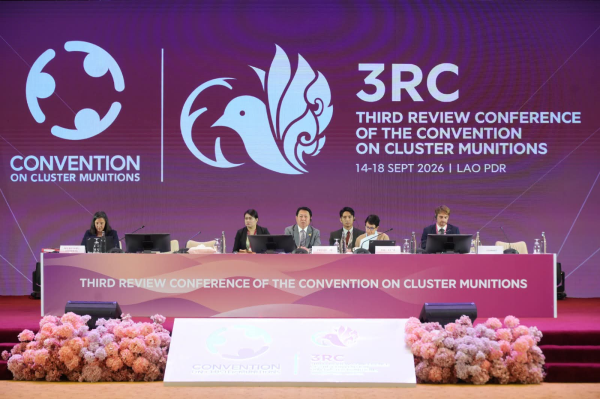
(KPL) The plenary sessions reviewed progress in implementing the Convention and discussed priorities for achieving a world free from cluster munitions. The session was chaired by Mr. Anoupharb Vongnorkeo, Deputy Minister of Foreign Affairs and Permanent Vice Chair of the National Regulatory Authority for UXO/Mine Action in the Lao PDR.
A central message of the discussions was that UXO action must ultimately improve safety and living conditions for affected people and communities. Delegates highlighted the importance of risk education, comprehensive assistance for survivors, including physical and psychological care, vocational training and social inclusion, as well as greater community participation in reducing UXO risks.
Strengthening Risk Education
Mr. Alomlangsy Lasavong, Deputy Director General of the Department of International Organizations at the Ministry of Foreign Affairs, reported that UXO risk education teams reached 582 villages and 252,576 people during 2026, while media campaigns reached an additional 875,714 people.
The Lao PDR is developing a National Explosive Ordnance Risk Education (EORE) Strategy for 2027–2030 to strengthen coordination, resource mobilization and monitoring, while making greater use of modern technology.
As Chair and host of the Review Conference, Laos has also placed emphasis on Action Measure 28 of the Vientiane Action Plan, which calls for continued international support and resource mobilization to expand risk education activities.
Expanding Assistance for Survivors
Mrs. Sudachan Dalounphan, Deputy Head of the NRA Office, reaffirmed the Lao government’s commitment to supporting survivors of cluster munitions and ensuring that affected people remain at the centre of UXO action.
Victim assistance is being integrated into broader national development efforts covering physical and mental health, social protection, education and livelihood opportunities, particularly for people living in remote rural areas.
A key priority for 2026 is the development of the Victim Assistance Action Plan 2027–2030, aligned with the National Socio-Economic Development Plan, the CCM, the Convention on the Rights of Persons with Disabilities and Sustainable Development Goal 18.
Calling for Sustained International Support
Mrs. Mukdavanh Sisoulith, Director General of the Department of International Organizations at the Ministry of Foreign Affairs, stressed that international cooperation and assistance remain essential to addressing the UXO challenge.
She highlighted the importance of national ownership, technical capacity building and knowledge sharing through sector working groups, while calling for funding that is diversified, predictable, sustainable and innovative.
The Lao PDR also called for stronger global partnerships and continued investment in human resources under the Vientiane Action Plan to build long-term national capacity for UXO action.
Cultural Performance Highlights Inclusion
An evening cultural performance was organised by the Association of Persons with Disabilities and Disadvantaged Persons of the Lao PDR under the theme “Promoting Victim Assistance.”
The performance highlighted the importance of social inclusion and opportunities for UXO survivors and persons with disabilities, reinforcing the message that assistance should extend beyond medical treatment to education, livelihoods, participation and inclusion in society.
The discussions and activities of the Review Conference underscore the continuing need for coordinated national and international efforts to reduce UXO risks, support survivors and help affected communities live more safely and pursue sustainable development.
KPL

