ຂປລ
A new waterway in southern China could reshape the movement of goods across the region, creating another link between China’s vast inland markets, the sea and ASEAN—and potentially opening new opportunities for landlocked Laos.
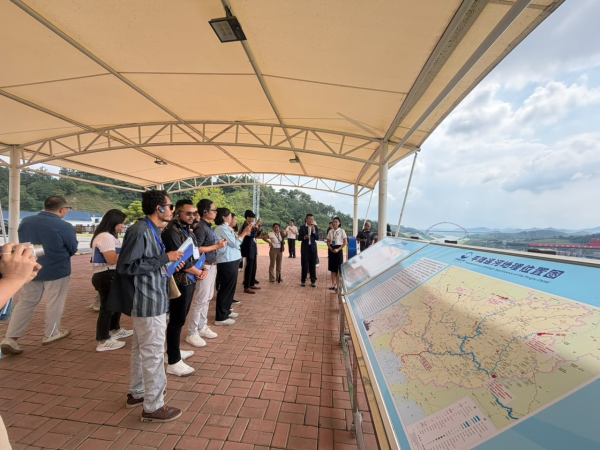
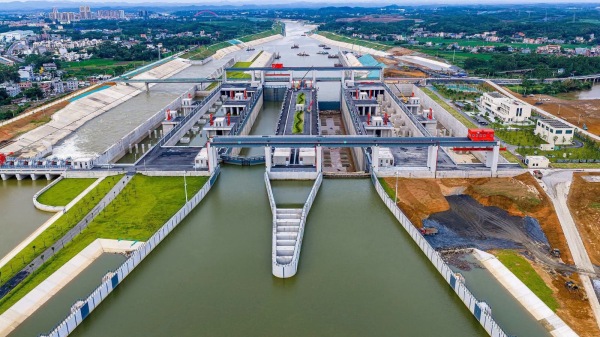
The Pinglu Canal, a 134.2-kilometre waterway in China’s Guangxi Zhuang Autonomous Region, officially began operations on September 16, connecting the Xijiang River with the Beibu Gulf.
At first glance, the canal may appear to be a Chinese infrastructure project with little direct connection to Laos. But its significance extends beyond China's borders.
For Laos, the canal could become part of a much larger regional logistics network—one that connects the Laos-China Railway, China's inland transportation system, Guangxi's ports and maritime routes serving ASEAN and international markets.
A new gateway to the sea
The Pinglu Canal is designed to provide a more direct waterway between China's inland areas and the sea.
According to information presented by the Guangxi Zhuang Autonomous Region Government, the canal is capable of handling vessels carrying up to 5,000 tonnes. It is expected to shorten transportation distances from southwestern China to the sea by more than 560 kilometres, while reducing overall logistics costs by an estimated 18 to 30 percent and saving more than 5 billion yuan annually in transportation costs.
The project addresses a long-standing geographical challenge.
Many rivers in Guangxi flow eastward toward the Pearl River Delta rather than directly south to the sea. As a result, goods from Guangxi and other inland areas of southwestern China have historically had to travel longer routes to reach major ports.
The Pinglu Canal creates a more direct connection to the Beibu Gulf, potentially making the region an important gateway for cargo moving between China's inland provinces and international markets.
Why does this matter to Laos?
Laos does not have a coastline, but its geographical location places it at the centre of mainland Southeast Asia.
For years, the country has sought to turn this position into an economic advantage by moving from being landlocked to land-linked.
The Laos-China Railway is central to this strategy.
The railway connects Kunming in southwestern China with Vientiane, providing a faster land transportation route for passengers and cargo between the two countries. From Laos, goods can also move toward Thailand and other parts of mainland Southeast Asia.
The development of the Pinglu Canal adds another potential layer to this network.
Imagine a Lao agricultural product travelling by road or rail from Laos into China. Instead of remaining entirely dependent on overland transportation, the cargo could potentially connect with China's wider rail, road and inland-waterway networks before reaching a southern Chinese port and continuing by sea to international markets.
The same network could work in the opposite direction.
Machinery, consumer goods and other products from China's inland provinces could move through China's transportation system toward Guangxi, enter maritime shipping routes and reach ASEAN markets.
In this wider picture, Laos could serve as an important land bridge between China and mainland Southeast Asia.
Infrastructure becomes a network
The real significance of the Pinglu Canal may therefore lie not in the canal alone, but in how it connects with other infrastructure.
Railways, highways, inland waterways and ports can function as separate transportation systems. When they are efficiently connected, however, they can become a regional logistics network.
Nanning could strengthen its role as an inland trade and logistics centre, while Qinzhou and other ports around the Beibu Gulf provide maritime access.
The Laos-China Railway, meanwhile, can connect China's southwestern region with Laos and the wider mainland ASEAN market.
Together, these links could provide businesses with more choices over how to move goods—by rail, road, water or sea, depending on cost, distance, cargo type and delivery time.
For exporters, having more than one route can be particularly important.
A growing China-ASEAN market
The need for efficient transportation is becoming increasingly important as trade between China and ASEAN expands.
According to Chinese government information, China-ASEAN trade reached US$1.05 trillion in 2025, surpassing US$1 trillion for the first time. Trade increased by 7.4 percent compared with the previous year.
China has remained ASEAN's largest trading partner for 17 consecutive years, while ASEAN has been China's largest trading partner for six consecutive years.
These figures illustrate the enormous scale of goods moving between the two sides.
As trade grows, logistics infrastructure becomes increasingly important—not simply to move more goods, but to move them faster, more efficiently and at lower cost.
This is where projects such as the Pinglu Canal could have wider regional significance.
An opportunity—and a challenge—for Laos
For Laos, the potential opportunity is not that Lao exporters will suddenly use the Pinglu Canal directly.
Rather, the opportunity lies in connecting to the network surrounding it.
With Laos-China Railway integrated with China's broader rail, road and waterway systems, Lao businesses can gain access to more transportation options and international markets.
But infrastructure alone does not automatically create trade opportunities.
To fully benefit from its geographical position, Laos would also need efficient border crossings, logistics centres, warehouses, customs procedures, cold-chain facilities and value-added processing industries.
For example, exporting agricultural products becomes more competitive when producers can combine reliable transportation with storage, processing and packaging facilities.
The same applies to manufactured goods. Instead of simply transporting raw materials across borders, Laos could seek to increase the value of products before they enter regional supply chains.
Geography as an advantage
The emergence of the Pinglu Canal offers a broader lesson for Laos.
Being landlocked has traditionally been viewed as a geographical limitation. But with modern railways, highways, border facilities and multimodal logistics networks, geography can be transformed into an economic advantage.
Laos sits between China, Thailand, Vietnam, Cambodia and Myanmar. Its location gives it the potential to serve as a connecting point between major markets in mainland Southeast Asia.
The question is whether the country's infrastructure and logistics systems can keep pace with that opportunity.
The Pinglu Canal cannot, by itself, transform Laos's trade position. Nor can the Laos-China Railway do so alone.
But when railways, highways, waterways and ports are connected across borders, they can form something much larger: a regional transportation system linking China's inland economy with ASEAN markets and global shipping routes.
For Laos, that could mean a new way of looking at its place in the region.
The future opportunity may not be about having a coastline. It may be about having efficient connections to the sea.
KPL

