ຂປລ
In the sweltering summer heat, the rice paddies of Yunnan Province in southwestern China are lush and green. More than 3,900 kilometers away, in Indonesia’s Bali Province, nearly 400 mu (approx. 26.7 hectares) of organic rice paddies are equally verdant, sustaining a friendship that spans more than 620 years. On June 30, the “Zheng He Odyssey: Global Friendship Envoy” Series of Cultural Exchange Activities was launched in Jakarta, Indonesia. At its side event—the International Symposium on the Global Civilization Initiative and the Spirit of Zheng He—representatives from China and Indonesia came together to share the story of friendship behind this “heart-to-heart rice” plant.
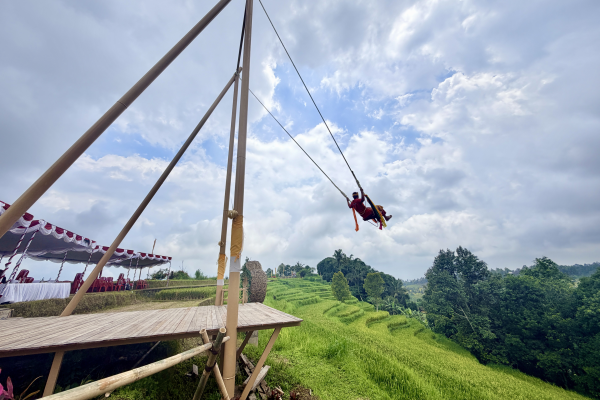
Tourists try out a swing beside the organic rice paddies in Bali Province, Indonesia. (Photo courtesy of the Yunnan Commercial Representative Office in Jakarta, Indonesia)
More than 620 years ago, the great Chinese navigator Zheng He—born in Jinning, Yunnan—made seven voyages to the Western Seas and visited the Indonesian archipelago on multiple occasions. What he brought was not only silk, porcelain, and tea, but also agricultural expertise including rice cultivation—sowing the seeds of early exchange and mutual learning between China and Indonesia.
In 2003, Yunnan Province and Indonesia’s Bali Province formally established a sister-province relationship. More than two decades later, an organic rice project from Yunnan—the hometown of Zheng He—took root in Bali, writing a new chapter in this sister-province friendship.
In 2024, the “Heart-to-Heart Connectivity • Yunnan in Action” project made its debut in Indonesia, implementing an organic rice cultivation project in the Jatiluwih area of Tabanan Regency, Bali Province. “The terraced landscape here bears a striking resemblance to the Honghe Hani Rice Terraces in Yunnan, providing a natural connection point for agricultural exchange between the two regions,” said Zhang Junlei, Deputy Director of Yunnan Commercial Representative Office in Jakarta, Indonesia (hereinafter referred to as the “Representative Office”), at the symposium. Now in its third year of implementation, the project—organized by the Yunnan Provincial People’s Association for Friendship with Foreign Countries and carried out by the Representative Office—has benefited more than 1,400 local residents to date.
Beyond providing production resources such as cattle, tractors, rice threshers, and high-quality rice seeds, the project has also organized a wide range of training programs covering organic farming, digital marketing, online product promotion, rural tourism, and rural entrepreneurship—training a total of 104 participants.
Today, new leisure facilities—including coffee kiosks and swings—have been built among the organic rice terraces. An increasing number of foreign tourists are visiting the area to experience rural tourism, purchase organic rice, and buy local handicrafts.
Eka Budiyasa, Chairman of the Indonesian Tourism Village Network Development Foundation, said the project has been a tremendous help in increasing local farmers’ incomes, revitalizing the rice paddies, and—more importantly—showing local communities the positive impact of organic agriculture.
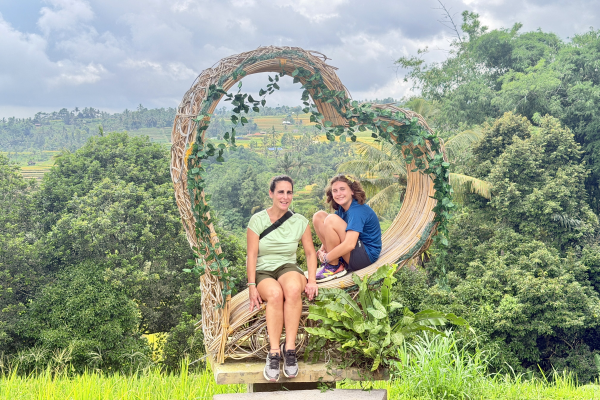
Foreign tourists visit the organic rice paddies in Bali Province, Indonesia, to take photos. (Photo courtesy of the Yunnan Commercial Representative Office in Jakarta, Indonesia)
The project will continue to develop the “Bali Organic” agro-tourism brand, promoting the integrated development of green agriculture and eco-tourism, while exploring the establishment of a long-term cooperation mechanism involving local governments, civil organizations, and farming households.
For Wayan, a local villager in his forties, the change has been deeply personal. His family has cultivated rice for generations under the Subak irrigation system—a traditional Balinese water management practice embodying the island’s agricultural wisdom. When the project first began, he hesitated to join, worried that farming without chemical fertilizers might reduce his yields.
After participating in the training, Wayan mastered techniques in organic composting and bio-pesticides. In the first season, his organic rice yield matched that of previous years, but the organic rice sold for more than double the price of conventional rice—boosting his income by about 30% in just one season.
Today, Wayan has become a “model organic farmer” in his village, and his rice paddies now serve as a demonstration site for agro-tourism integration. He has taken the initiative to share his experience with fellow farmers, encouraging 23 households to join the program. “I never thought we could farm without chemical fertilizers,” he said. “Now I know that the land can grow healthier with each season.”
Wayan’s story is just one example of the broader transformation taking place in the community. In Zhang Junlei’s view, what is even more valuable than increased yields is the growing trust among local villagers. To honor that trust, the project team has been paying close attention to other needs in the community.
Zhang Junlei recalled a household visit in December 2024, when the team sat down with villagers for a heart-to-heart conversation. As night fell, with no streetlights in sight, they talked by the faint glow of a courtyard light. A villager, Niluh, expressed her gratitude to the project team for helping them grow better rice and increase their income. She shared her hope for a brighter future—one with streetlights so that children could play safely at night and neighbors could visit each other freely after dark.
The villagers’ words inspired the project team to expand its agricultural support into rural public services. Zhang Junlei explained: “We are now preparing for the third phase of the project. In addition to adding about 10 hectares of organic rice cultivation, we also plan to install solar-powered streetlights to improve nighttime travel conditions for the villagers.”
Notably, these streetlights will incorporate Chinese cultural elements, featuring bilingual signage in Chinese and Indonesian—turning lighting infrastructure into a showcase for both utility and culture. “We hope to improve the villagers’ production and living conditions while advancing organic agriculture, green energy, and people-to-people exchange in tandem,” Zhang Junlei said.
This “heart-to-heart rice” plant also reflects the deepening of Yunnan’s international cooperation in livelihood projects.
From 2022 to 2025, the Yunnan Provincial People’s Association for Friendship with Foreign Countries, focusing on Southeast Asia, South Asia, and the Indian Ocean region, implemented 187 “Heart-to-Heart Connectivity • Yunnan in Action” projects across 24 countries. Covering areas such as infrastructure, agricultural technology, green energy, healthcare, education support, and people-to-people exchange, these projects have benefited 153 overseas communities (villages) and 201 schools, reaching an estimated 4.6 million people directly and indirectly.
From the agricultural technology exchanges of Zheng He’s era to today’s integrated agro-tourism projects taking root once again in Indonesia, this “heart-to-heart rice” plant—spanning mountains and seas—connects two lands, and the shared vision of development between their people.
KPL

