ຂປລ
The Ministry of Education and Sports of the Lao PDR (MoES), with support from the Australian Government through the BEQUAL program, began filming the fourth episode of the national Education Promotion campaign this week. Led by the Research Institute for Educational Sciences (RIES) and produced by RIES’ Information Media Center (IMC), the episode titled “The Village That Supported Education” highlights a compelling, community-driven response to declining school attendance and demonstrates how collective action can help secure brighter futures for children.
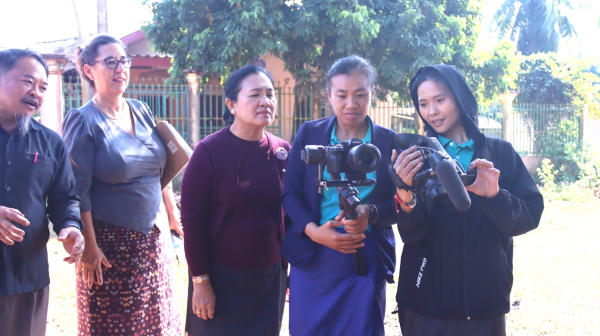
Mrs. Daravone Kittiphanh, Vice Minister of Education and Sports (center) visits the filming set to encourage the team
Mrs. Daravone Kittiphanh, Vice Minister of Education and Sports, visited the filming set on the first day to observe the production process and encourage the team. She reaffirmed the significance of the campaign in transforming perceptions of education. “This campaign is about building a shared vision: when communities value schooling, children gain the skills they need to thrive and our nation grows stronger. By showing how teachers, families, and communities can work together, we aim to change attitudes and make education a priority for every family,” she stated.
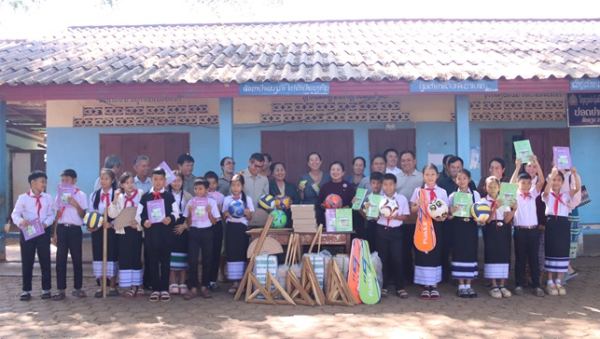
Mrs. Daravone presents gifts to the school in thanks for volunteering for the film
The storyline follows three children whose lives are transformed after their village decides to champion education. Dao stays home to help with chores instead of attending school; Phone spends his days playing; and Phern, who has a physical disability, is not enrolled. Recognizing the long-term consequences of low school attendance, the village chief convenes a community meeting. The village responds with collective action: parents repair the school, teachers work with families, fathers help provide textbooks, mothers accompany children to class, and grandparents support learning at home. The film then shifts twenty years into the future, showing the outcome of this shared commitment: Dao returns as an architect, Phone as a nurse, and Phern as a teacher. The episode concludes with the three characters sharing their experiences with a new generation of students.
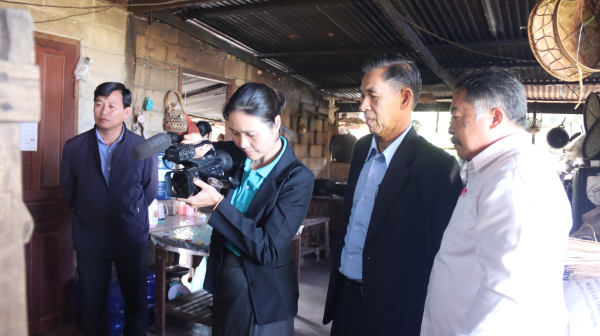
Mr. Outhid Thipmany, DDG of RIES, observes thescene where a teacher visits parents to urge them to school their child with disabilities
“This episode powerfully shows that education is not only a family matter but a community responsibility,” Mrs. Daravone added. “When communities join together to remove barriers to schooling, the benefits extend across families and generations. I congratulate the production team and all community volunteers for bringing this vital message to life.”
Ms. Vanessa Hegarty, First Secretary at the Australian Embassy, also highlighted Australia’s support for the initiative. “Australia is proud to support a campaign that showcases real, practical ways communities can help keep children in school. By telling authentic stories rooted in local experience, these videos help parents appreciate the lifelong value of education and inspire young people to continue learning. We congratulate everyone involved in this important production.”
.jpg)
Production team and volunteer actors from Episode 4 of the Education Promotion campaign
Filming is taking place across several village locations, including the primary school, local gardens, family homes, a pho restaurant, the village meeting hall, and the district hospital. Community participation has been enthusiastic, with more than 80 villagers volunteering as actors, along with nearly 200 students and teachers. The production team has coordinated closely with provincial and district education authorities, as well as MoES’ Inclusive Education Promotion Center, to ensure an inclusive cast and realistic scenes—featuring, for example, a female village chief and a key character with a disability portrayed by both a student and an adult teacher.
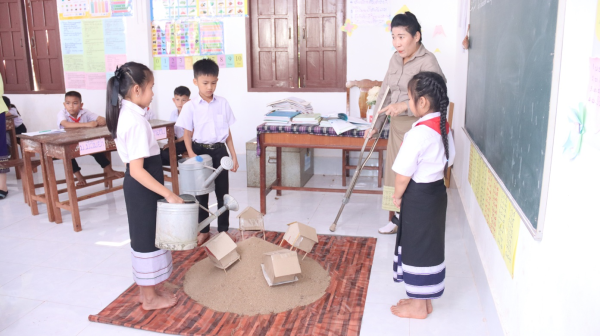
The video also includes climate change education, shown in a classroom experiment about a landslide
Ms. Hegarty further noted that “this episode promotes gender-equitable roles through the inclusion of female community leaders, men sharing childcare and household responsibilities, and meaningful representation of people with disabilities. Australia strongly believes that advancing gender equality, disability inclusion, and social equity is essential for changing attitudes and creating opportunities for all children.”
The Education Promotion campaign consists of four videos designed to bring together students, parents, teachers, and community leaders to reshape perceptions of the value of schooling. The first two episodes have already been broadcast nationally on television, shared widely on social media, and distributed to education officials and community advocates for use in local outreach. MoES and its partners encourage the public to continue sharing these videos to reach audiences at the village, district, and provincial levels.
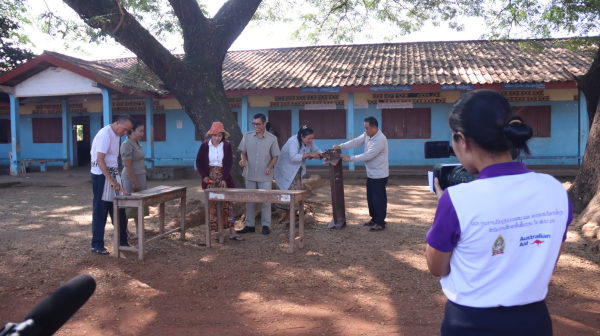
To show that education is everyone's responsibility, a scene shows teachers and villagers working together to repair school furniture
Mrs. Daravone concluded by expressing gratitude for ongoing international support. “We thank the Australian Government for its financial and technical assistance for this important campaign. Through the BEQUAL program, Australia is helping build local capacity by providing hands-on training in scriptwriting, casting, and inclusive storytelling. I have seen the high quality and emotional impact of this production, and I hope it will help change perceptions across communities. The Ministry looks forward to releasing the final episode and continuing the nationwide dialogue on why every child in Laos deserves the opportunity to learn.”
KPL

