ຂປລ
In a comprehensive lecture delivered on July 30 at the University of International Relations, Associate Professor Zhong Houtao offered a detailed examination of the One-China principle, the evolution of Cross-Strait relations, and the foundational framework of "One Country, Two Systems."
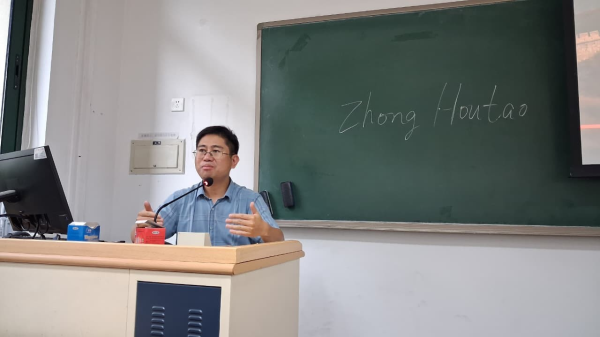
Professor Zhong outlined the historical context, modern policy shifts, and strategic considerations shaping China's approach to national reunification.
The Four Core Red Lines in U.S.-China Relations
Professor Zhong highlighted the strategic friction points between Beijing and Washington, identifying four critical issues that China views as red lines with Taiwan issue described as the most sensitive, vital, and core interest in bilateral relations.
Central to these dynamics is the One-China principle, which asserts that Taiwan is an inalienable part of China—a status anchored in history, international law, and domestic legislation.
Historical Foundations and Legal Framework
Tracing the historical timeline, Professor Zhong emphasized that Taiwan’s status as part of China is backed by centuries of records and international treaties.
Administrative control dates back centuries, including records from the Three Kingdoms period and its formal establishment as China's 20th province during the Qing Dynasty.
Following the First Sino-Japanese War in 1894, Taiwan was ceded to Japan in 1895. It was restored to China in 1945 following the conclusion of World War II, a return formally codified in international frameworks such as the Cairo Declaration (1943) and the Potsdam Proclamation.
Post-1949 Separation
Following the Chinese Civil War in 1949, the Kuomintang (KMT) retreated to Taiwan, leading to a decades-long separation. A major diplomatic milestone occurred in 1971 with United Nations Resolution 2758, which restored the lawful rights of the People's Republic of China (PRC) as the sole legitimate representative of China to the UN.
The Evolution of "One Country, Two Systems"
First conceptualized by Deng Xiaoping in 1979 alongside the policy of peaceful reunification, "One Country, Two Systems" was designed as a creative formula to resolve the Taiwan question while being successfully implemented first in Hong Kong (1997) and Macau (1999).
Professor Zhong contrasted the policy approaches across successive leadership eras with Mao Zedong Era focused heavily on military resolution during early cross-Strait confrontations and Deng Xiaoping Era shifted toward peaceful reunification and introducing the "One Country, Two Systems" framework.
Jiang Zemin & Hu Jintao Eras were emphasized cross-Strait dialogue, economic exchange, and party-to-party interactions.
A historic milestone occurred in 2005, when Hu Jintao met with then-KMT Chairman Lien Chan in Beijing—the first meeting between top CCP and KMT leaders since 1949.
Xi Jinping Era (The New Era)
Focus has shifted toward integrated development ("peaceful integration"), premised on the belief that deep socio-economic integration will naturally foster reunification. A pivotal moment occurred in 2015, when President Xi Jinping and Taiwan leader Ma Ying-jeou held a historic summit in Singapore, establishing a direct precedent for leader-level dialogue across the Strait.
Economic Convergence and the Path Forward
Highlighting shifting economic realities, Professor Zhong pointed to the dramatic economic transformation of mainland provinces compared to Taiwan. Citing Guangdong Province as an example, he noted that while Taiwan's economy once significantly outpaced Guangdong decades ago, Guangdong's rapid growth under reform and opening-up has altered the relative economic scale, with Guangdong's GDP now standing at approximately four times that of Taiwan.
Key Takeaways on Future Reunification
Professor Zhong emphasized that the timing and exact method of reunification are secondary to ensuring long-term peace, stability, and development for the Taiwan region post-reunification.
The application of "One Country, Two Systems" in Taiwan will depend heavily on the manner of reunification. A peaceful resolution would allow for a highly flexible framework and broad development space for Taiwan within the national market.
Beijing views complete national reunification as an indispensable component of the broader historical process of national rejuvenation (minzu fuxing), targeting resolution within the middle of the 21st century.
KPL

