ຂປລ
Recently, China sent a Gravity-1 carrier rocket into space from waters off the coast of Haiyang, east China's Shandong province, placing three satellites into their designated orbits. This launch exemplifies the growing momentum of China's emerging commercial space sector, which is contributing significantly to the country's space exploration capabilities.
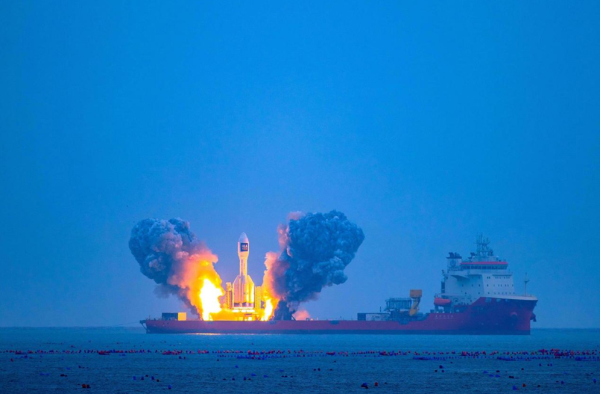
A Gravity-1 carrier rocket carrying a wide-field satellite and two experimental satellites blasts off from the waters off Haiyang, east China's Shandong province, Oct. 11, 2025. (Photo/Wang Yueguo)
By Li Rui, People's Daily
The global competition in commercial spaceflight is intensifying. According to projections, the scale of China's commercial space market is expected to exceed 2.5 trillion yuan ($351.76 billion) this year. Through a strategic collaboration between the government and private enterprises, China is achieving a dynamic synergy that is accelerating technological advancements, reducing costs, and expanding the range of applications within its space industry. As a result, China's space industry is gaining more visibility and vibrancy on the global stage.
China's development of "space infrastructure" is advancing steadily, especially as the deployment of low-orbit satellite internet networks enters a phase of large-scale constellation expansion. However, the country faces a prominent challenge: the demand for satellite launches now exceeds the available capacity of traditional rockets. Relying solely on traditional rockets is far from sufficient to meet these growing needs.
In this context, the development of commercial space initiatives is essential to providing the necessary launch capacity for widespread space-based network deployment. This year, a new generation of commercial rockets, including the Zhuque-3, Tianlong-3, and Gravity-2, are advancing according to schedule with design, testing, and launch activities. These new launch vehicles will effectively alleviate the strain on satellite launch resources and bolster the development of China's national satellite internet infrastructure.
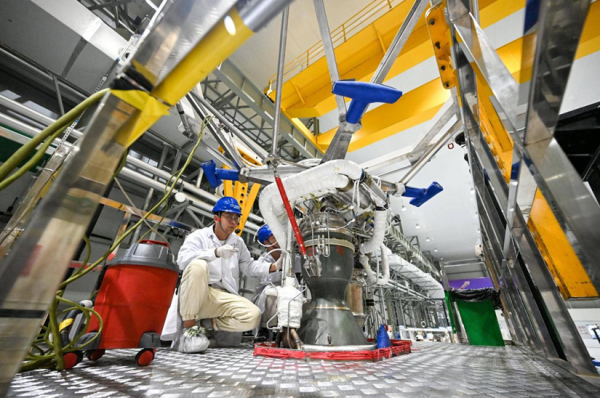
Technicians assemble a liquid oxygen-methane rocket engine at the general assembly plant of Chinese commercial rocket firm LandSpace in Huzhou, east China's Zhejiang province. (Photo/Huang Yangyang)
Commercial spaceflight not only increases the frequency of launch opportunities but also opens up a broader range of technological possibilities. Unlike state-run space enterprises, private commercial companies are more agile and adaptable.
For example, the methalox engine independently developed by Chinese commercial rocket firm LandSpace has drawn global attention for its cost-effectiveness, clean propulsion, and reusability. Similarly, Chinese aerospace company Galactic Energy has significantly reduced rocket engine manufacturing costs through 3D printing.
Fueled by market-driven mechanisms and following a model of "small steps, rapid iterations," commercial space enterprises have gained the favor of numerous research institutions. These companies serve as a strong complement to state-run space organizations, further advancing China's space exploration capabilities.
As a dynamic sector driving the future of technological innovation, commercial spaceflight holds vast market potential. More than 10 provinces across China have introduced specific policies to support the development of the commercial space sector, fostering a wave of specialized and innovative companies focused on rocket development and satellite manufacturing. These initiatives have led to the creation of industrial clusters and a rapidly expanding "space economy" ecosystem.
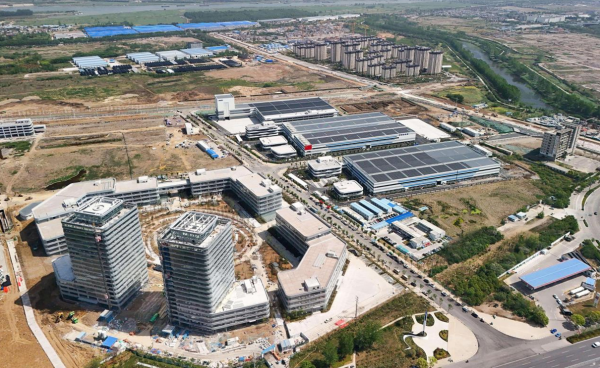
Photo taken on April 23 shows a commercial space industrial park in Bengbu, east China's Anhui province. (Photo/Huang Yangyang)
For instance, Beijing is developing a regional industrial layout with rocket production in the south and satellite manufacturing in the north, while Shanghai aims to scale its space industry to hundreds of billions of yuan. Additionally, the aerospace industrial park Wuxi, east China's Jiangsu province, has brought together more than 120 enterprises above the designated size, fueling growth and innovation.
As the commercial space sector shifts from isolated efforts to more integrated, clustered development, an autonomous, resilient, and competitive industrial ecosystem is taking shape, becoming a significant driver of economic growth and technological advancement in space.
Today, commercial spaceflight not only serves national missions but is also expanding its innovation to meet everyday needs. Applications such as satellite remote sensing allow farmers to manage irrigation systems via a mobile phone, while satellite internet provides broadband access to remote areas, including mountains and oceans. Moreover, satellite-enabled intelligent transportation systems are optimizing traffic signal timing to reduce congestion.
These innovations highlight how space technology, once perceived as distant and exclusive, is now becoming an integral part of everyday life, enhancing communications, supporting agriculture, improving mobility, and providing tangible benefits to the public.
Commercial spaceflight represents a vast frontier of opportunity. It is not only a scientific domain for exploring the unknown but also a burgeoning economic sector with boundless potential for the future.
KPL

