ຂປລ
The government has approved in principle a 10-year roadmap to promote electric and new energy vehicles, along with draft decrees on asset seizure and confiscation and state digital data management, during its regular Cabinet meeting for November 2026.
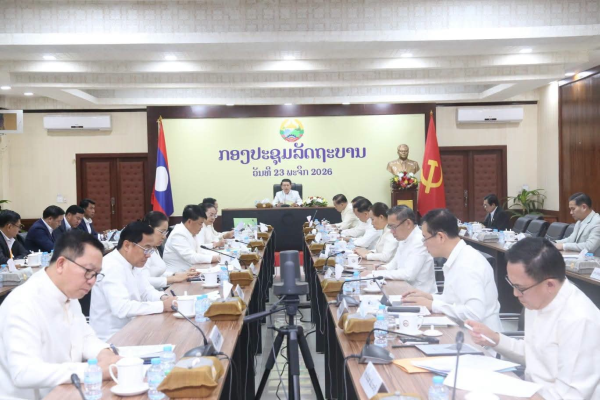
The meeting, chaired by Prime Minister Saleumxay Kommasith at the Prime Minister’s Office in Vientiane on November 23, reviewed the country’s economic and social performance, key policy issues and priorities for December. Deputy Prime Minister and Cabinet members attended in person, while local authorities joined via video conference.
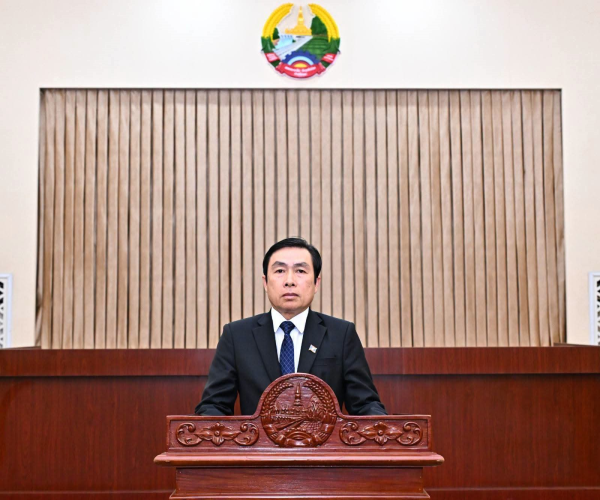
Deputy Minister and Deputy Head of the Prime Minister’s Office Khampha Phimmason briefed the media on the meeting’s outcomes.
Progress in Security and Economic Management
The Cabinet reported progress in security, economic management, infrastructure development and international cooperation, while acknowledging continued challenges in crime, illegal mining, trade and domestic production.
From October to early November, authorities dealt with 299 drug-related cases and dismantled six online scam networks, arresting 51 suspects from seven nationalities. Security forces also recovered 224 pieces of unexploded ordnance and seized 39 excavators, three pickup trucks and other equipment in operations against illegal mining in several provinces.
Meanwhile, Task Force 1885 of the Ministry of Finance consolidated 103 seized vehicles across eight provinces between April and November. Of these, 33 vehicles worth 10.8 billion kip have been sold, with the remaining assets expected to generate an estimated 30 billion kip.
Budget revenue reached 92% of the annual target as of November 17, representing a 19% increase, or approximately 12 trillion kip, compared with the same period last year. Budget expenditure stood at 68%, while financing to balance the budget from domestic and foreign sources reached 69%.
Average inflation was maintained at 7.7%, and foreign exchange reserves as of November 13 were sufficient to cover 5.66 months of imports.
In land and infrastructure development, authorities issued more than 167,000 land titles, equivalent to 120% of the annual target. Toll collection on Route 9 began on November 16 as a pilot under road maintenance policies, generating at least 700 million kip per day.
The government also received road maintenance machinery and equipment from Japan, completed the handover of Chao Anouvong Stadium and upgraded the University of Health Sciences to the National University of Health Sciences ahead of the 2026–2027 academic year.
In diplomacy, Lao leaders attended major international gatherings, including the 20th Francophonie Summit in Cambodia and the 49th ASEAN Summit and related meetings in the Philippines, while also receiving foreign delegations.
Four Key Agenda Items Approved
The Cabinet approved in principle four key agenda items.
The first was the draft 2026–2035 Master Plan and Action Plan for Promoting Electric and New Energy Vehicles (XEV). The Ministry of Industry and Commerce was instructed to work with relevant agencies to refine the plan, including measures to prevent imports of substandard or degraded vehicle batteries and address end-of-life vehicles, spare parts and waste management. The ministry will also develop sector-specific implementation plans and update the appointment of the responsible committee.
The second was a draft decree on provisional measures for the seizure, freezing and confiscation of assets linked to criminal activities, including money laundering and terrorist financing. The Bank of the Lao PDR and relevant agencies were tasked with strengthening procedures, clarifying terminology and standards for suspicious information and evidence, and improving urgent response measures.
The third was a draft decree on state digital data management. The Ministry of Technology and Communications was instructed to refine provisions covering confidential information, internal data protection and national security before submitting the revised draft to the Prime Minister and Deputy Prime Ministers.
The fourth agenda item focused on the government's work priorities for December, aimed at completing key tasks and preparing for the year-end review.
Government Sets December Priorities
For December, the Cabinet called on ministries, agencies and local administrations to strengthen efforts to combat cybercrime, online scams, money laundering, drug trafficking, illegal trade, illegal logging and other criminal activities. Public awareness campaigns and measures to counter fake news were also highlighted.
Preparations must be completed for the 4th Plenum of the 12th Party Central Committee and the 2nd Expanded Cabinet Meeting of 2026. Ministries and agencies were instructed to finalize their 2026 performance reviews and 2027 work plans, alongside assessments of key government policies on inspection, revenue collection and road development.
The Cabinet also called for stronger revenue collection, particularly in provinces at risk of missing their annual targets. Priorities include collecting outstanding taxes and other obligations, auditing investor commitments, auctioning seized assets, collecting border checkpoint fees and preparing plans to address domestic and external debt.
On economic management, authorities were instructed to maintain exchange-rate stability and control prices of essential goods and services. The government will also strengthen oversight of approved mining operations, inspect rare-earth exploration and processing projects nationwide, and accelerate preparations for the revised mining management order and electric vehicle development plan.
Infrastructure development will remain a priority, with efforts to speed up road projects, including National Roads 13 North and South, 8, 12 and 2E. The government will also advance major regional transport links, including the Laos–China Expressway, Laos–Vietnam Railway and Phase 2 of the Vientiane–Hanoi Expressway, covering the Bolikhan–Nam On border checkpoint section.
Ministries were further instructed to assess road investment priorities and financing options, including Build-Operate-Transfer (BOT), Output- and Performance-Based Road Contracts (OPBRC) and state budget funding, for consideration at the December Cabinet meeting.
Other priorities include rural development and poverty reduction, agricultural production, forest protection, land registration, disease prevention, workforce development and tighter management of foreign labour.
The Cabinet also stressed the need to reduce school dropout rates, strengthen disease surveillance and vaccination, inspect private hospitals and beauty clinics, and improve food and drug safety. Tourism authorities were urged to promote traditional festivals, improve visitor safety and enforce regulations on entertainment venues and restaurants operating beyond permitted hours.
In foreign affairs, relevant agencies were instructed to closely monitor regional and international developments and prepare for senior leaders' official visits and participation in the ACMECS and CLMV summits in Vietnam.
Prime Minister Saleumxay urged Cabinet members and local leaders to translate the agreed priorities into detailed work plans, with clear responsibilities, realistic targets and firm deadlines to ensure effective implementation at every level.
KPL

