KPL
On a weekend night, on an open stage in the Ninth Street of Guanyinqiao business area, Jiangbei district, southwest China's Chongqing municipality, people were singing and dancing, creating a lively atmosphere.
"We come here to listen to music, enjoy food, and go shopping. The Ninth Street never sleeps at night," said Chen Qi, a young local resident.
Just across the street, at the Beicang Cultural and Creative Block, a 24-hour bookstore was filled with young readers, who are drawn to the artistic night market.
By Lin Lili, Huang Xiaohui, Wang Xinyue, People's Daily
(KPL) On a weekend night, on an open stage in the Ninth Street of Guanyinqiao business area, Jiangbei district, southwest China's Chongqing municipality, people were singing and dancing, creating a lively atmosphere.
"We come here to listen to music, enjoy food, and go shopping. The Ninth Street never sleeps at night," said Chen Qi, a young local resident.
Just across the street, at the Beicang Cultural and Creative Block, a 24-hour bookstore was filled with young readers, who are drawn to the artistic night market.
The night economy is an important part of urban commerce. In China, the booming night economy has evolved from traditional night markets centered around dining and shopping to integrated hubs for culture, tourism, and entertainment.
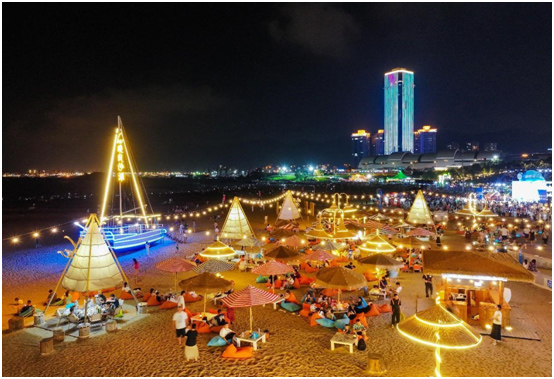
Photo shows a night view of a beachside park in Lianyungang, east China's Jiangsu Province. (Photo by Wang Jianmin/People's Daily Online)
Cities across the country are striving to boost nighttime cultural and tourism consumption and offer a wide range of nighttime activities in line with local conditions, injecting fresh energy into the consumer market.
For instance, the 5th Tianjin Nighttime Life Festival was recently held in north China's Tianjin municipality, including over 100 events integrating shopping, tourism, culture, and sports.
In Shenyang, capital of northeast China's Liaoning province, the First Traditional Chinese Medicine (TCM) Culture Night Market was launched, where people could learn traditional Chinese fitness exercises like Baduanjin, Wuqinxi, and Tai Chi from experts.
Shijiazhuang, capital of north China's Hebei province, has integrated business models such as nighttime entertainment, tourism, and sports, providing a range of sports activities for its residents.
Apart from diverse and vibrant urban nighttime activities, the night economy in Chinese rural areas also has its unique appeal.
For example, in Wangjiazhuang village, Lingtai county, Pingliang, northwest China's Gansu province, people came together for vibrant bonfire parties and village basketball competitions, also known as "CunBA" usually held after sunset.
Local farmers in Shuijing village, Zhenning county, Anshun, southwest China's Guizhou province, tapped into the beauty of a vast lotus pond to attract visitors to come and appreciate the lotus flowers while tasting local snacks.
According to Pan Helin, an official with China's Ministry of Industry and Information Technology, the Chinese night economy is flourishing with numerous highlights: themed night markets with cultural and creative products and delicious food have enriched the options for nighttime consumption; nighttime bookstores and museums are merging with technology and cultural tourism sectors to create new consumption models. "All these services cater to the unique and wide-ranging demands of Chinese consumers," Pan added.
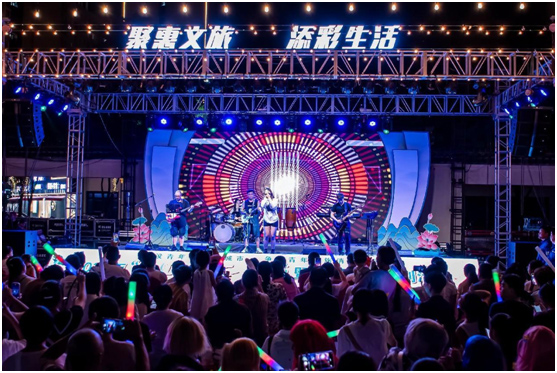
A music festival is held in a commercial area in Honghu, central China's Hubei province, August 10, 2024. (Photo by Wang Xin/People's Daily Online)
However, as the night economy develops, residents living near commercial districts inevitably face disturbances such as nighttime noise, lights, and cooking fumes. While promoting the night economy, regions across the country have improved their management and provided better public services to minimize the negative impacts on the surrounding environment.
For instance, Maoming North Road located in Nanjing West Road business circle in Shanghai's Jing'an district has turned into a pedestrian street every weekend and on all Chinese national holidays. This year, during events like the UEFA EURO football championship and the Paris Olympics Games, some bars and restaurants there were allowed to extend their opening hours from 1 a.m. to 3 a.m. on weekends.
It is reported that relevant local government departments have reached agreements with nearby businesses and shop owners on the allocation of outdoor business areas, maintaining consistent LED brightness levels and prohibiting outdoor loudspeaker advertisements at night. In addition, the property management company of the pedestrian has set up a self-regulating committee for shop owners to oversee and enforce these regulations.
The Chinese night economy is developing in tandem with new business forms such as on-demand retail and community e-commerce, better meeting consumers' nighttime consumption needs.
"I was worried about my child getting cold while swimming at night, so I ordered a few cups of hot ginger tea and some snacks. To my surprise, they arrived in just over 10 minutes," said Yu Mengying, a resident in Lianyungang, east China's Jiangsu province, who was unfolding a picnic blanket on a beach.
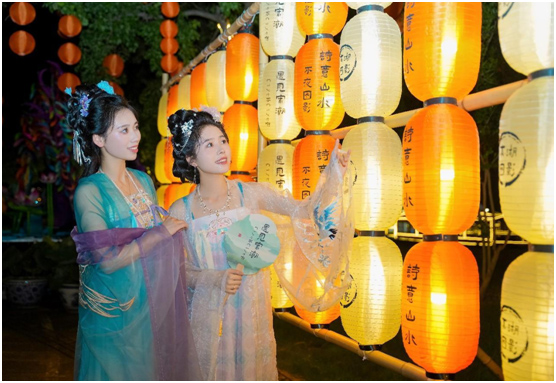
Tourists visit a lantern fair in a wetland park in Changxing county, Huzhou, east China's Zhejiang Province, August 2, 2024. (Photo by Chen Haiwei/People's Daily Online)
"Now we can travel light as we don't need to take too many things with us. We can place orders on our phones anytime, and the delivery is fast," she said.
New technologies like big data have also improved the management and service quality of the Chinese night economy.
At the Caita night market in Shenyang, a market regulation enforcement officer was checking food vendors using a smart monitoring platform while recording his findings on a mobile application. The inspection was completed in just five minutes.
"We don't need to carry inspection documents with us, which removes the burden of managing and storing the paperwork, leading to a notable improvement in regulatory efficiency," said Zhang Zhaoyu, an official with the Shenyang Administration for Market Regulation.
It is reported that Shenyang has included nighttime food safety regulation into a smart supervision platform, aiming to achieve comprehensive smart supervision through mobile terminals.
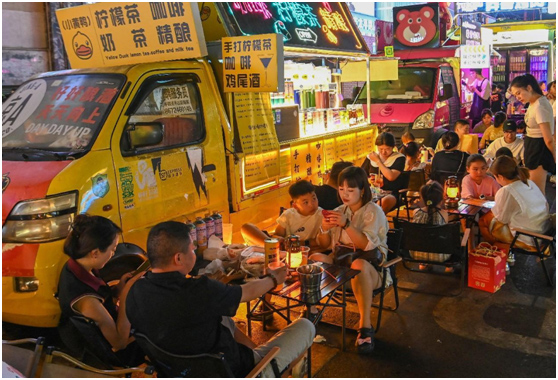
Tourists taste snacks at a night market in Guiyang, southwest China's Guizhou Province, August 18, 2024. (Photo by Qiao Qiming/People's Daily Online)
KPL

