KPL
Laos’s first “Green Energy TO Zero-Carbon Library,” equipped with integrated photovoltaic, energy storage and charging facilities and built with China’s assistance, has been launched.
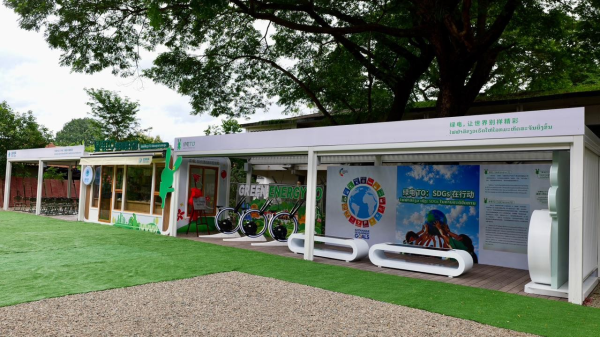
Laos’ first integrated “zero-carbon library” featuring photovoltaic power generation, energy storage and EV charging.
Laos’s first zero-carbon library featuring an integrated photovoltaic, energy storage and charging system was officially inaugurated on August 29 at Luang Prabang Peace Secondary School, marking another “Small yet beautiful” livelihood project under China-Laos Belt and Road cooperation.
Located at the junction of the Mekong and Nam Khan rivers, the school welcomed the new facility on the eve of the new academic term. The library was built with assistance from China’s Zhejiang Province and combines green energy technology with education, providing students with a modern and comfortable space for reading and learning.
The project comes as China and Laos mark the 65th anniversary of their diplomatic relations and launch the jointly declared “China-Laos Friendship Year.” In June, Lao President and General Secretary of the Lao People’s Revolutionary Party Thongloun Sisoulith visited China, making Zhejiang his first stop. During the visit, the two sides reached a series of agreements on deepening the construction of a China-Laos community with a shared future.
Inside the new library, air conditioning provides relief from the heat outside, while computers, televisions, bookshelves and Chinese-Lao bilingual books offer students new opportunities for study. A digital library also allows them to search for information and broaden their knowledge.
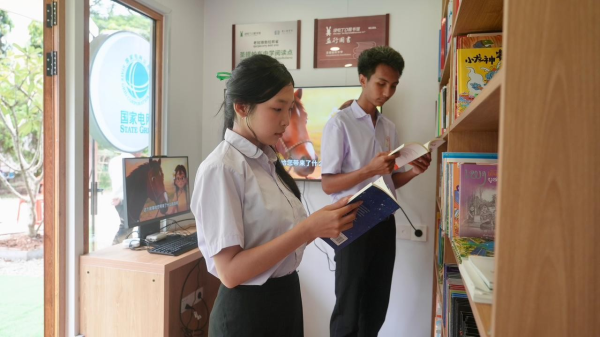
Students read in the digital reading room.
“Since the China-Laos Railway opened, we have been exposed to many new things, such as artificial intelligence and the digital economy,” said Zalen, a second-year student at the school. “Reading has become our way to broaden our horizons and gain knowledge.”
Previously, extracurricular reading resources were limited, and students seeking a wider selection of books sometimes had to travel more than 200 kilometers to Vientiane, a journey that can take about two and a half hours one way.
“Now the library is right outside the classroom. There are many books I want to read here, and there is air conditioning too. It feels especially convenient and comfortable,” Zalen said.
Principal Bounkham Vansy said the library serves as more than a reading room, describing it as “another passage to the outside world” after the China-Laos Railway. He said the school would integrate the facility into daily teaching and make full use of it to support students’ growth.
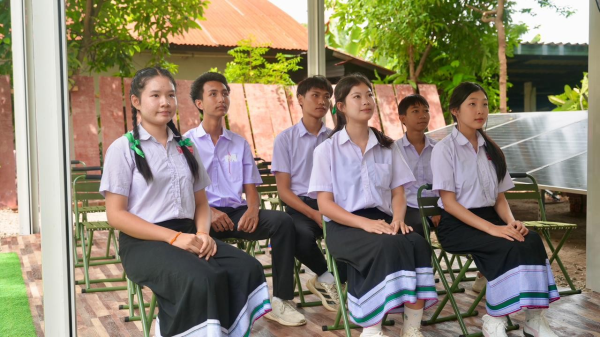
Lao students explore Chinese culture and the fascinating world of science through the “Cloud Classroom.”
The project also addresses local energy challenges. Although Laos has abundant hydropower resources, seasonal changes in water flow can put pressure on electricity supplies during the dry season. In parts of northern Laos, including Luang Prabang, limited power grid infrastructure can also create challenges.
To address these issues without waiting for a comprehensive grid upgrade, the “Green Energy TO” public welfare team of State Grid Zhejiang Electric Power Co., Ltd. introduced an integrated photovoltaic-storage-charging microgrid solution. The library was manufactured as prefabricated cabins in Zhejiang and assembled in Laos in just four days.
During the day, rooftop photovoltaic panels generate electricity, while surplus power is stored in an energy storage system. At night, the stored electricity is released to provide a stable supply, helping the library operate with a low-carbon energy model.
An “Air Classroom” was also launched alongside the library, connecting students in Luang Prabang with Gaoqiao Junior High School in Xiaoshan District, Hangzhou, Zhejiang. Through online lessons, Chinese teachers introduced Lao students to Chinese culture and science, while students from both countries shared stories about their respective cultures.
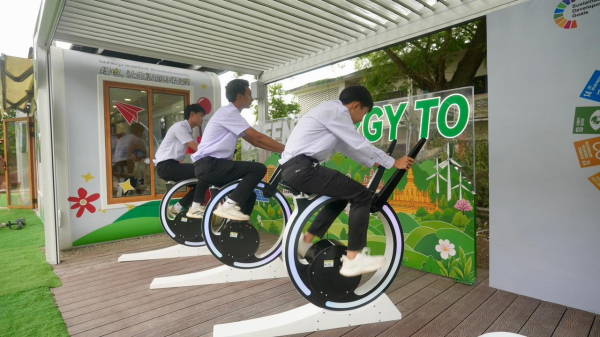
At the UN Sustainable Development Goals Popular Science Education Base, students enthusiastically pedal a power-generating bicycle.
Students also participated in hands-on activities, including assembling a robotic dog and exploring a science education base focused on the United Nations Sustainable Development Goals. Power-generating bicycles, photovoltaic panels and solar-powered benches helped students experience concepts such as green energy and sustainable development firsthand.
Zhang Jun, head of the “Green Energy TO” public welfare team, said the project has created a new model combining “new energy + new education.” In the future, partners plan to provide 21 hours of online classes covering areas including natural science and traditional culture.
From reading and online classes to science activities and cultural exchanges, the “one library, one classroom, and one base” model brings green energy into students’ everyday educational experience.
Mr. Khamla Lianbadi, Deputy secretary of the Luang Prabang Provincial Party Committee, said the project had brought advanced power technology to Laos while promoting ideas about green and low-carbon development.
At the inauguration ceremony, Chinese and Lao representatives jointly planted a Champa tree, Laos’s national tree. As the sapling took root and sunlight fell across the library’s photovoltaic panels, the project symbolized growing educational and people-to-people ties between China and Laos.
KPL

