KPL
The Lao PDR has taken a significant step toward restoring wild tigers with the finalization of the National Tiger Recovery Action Plan (NTRAP) 2026–2035, a long-term national framework designed to guide conservation efforts in priority ecological landscapes across the country. The plan comes at a critical time, as there has been no confirmed scientific evidence of wild tigers in Laos since 2013, when the last individual was recorded by camera traps in Nam Et–Phou Louey National Park.

The NTRAP responds to the urgent need to prevent the local extinction of tigers and to create the ecological, institutional, and social conditions necessary for their future recovery. Its development reflects Laos’ commitment as a tiger range country and aligns with the Global Tiger Recovery Programme and national strategies on forests and biodiversity.
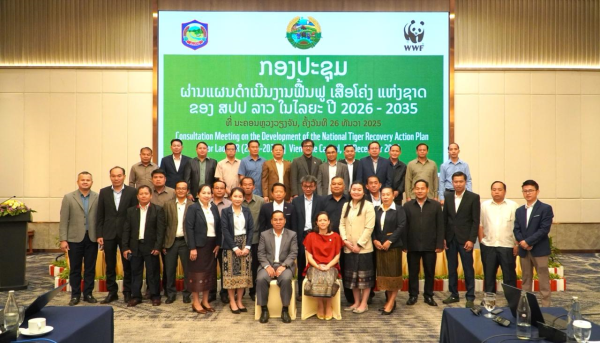
The final consultation meeting for the Action Plan was held on 26 December 2025 in Vientiane Capital. Organized by the Department of Forestry under the Ministry of Agriculture and Environment, with support from WWF-Laos, the meeting brought together provincial forestry authorities from areas with high recovery potential, wildlife and law-enforcement agencies, conservation organizations, and development partners. The meeting was co-chaired by Mr. Thoumthone Vongvisouk, Deputy Director General of the Department of Forestry, and Ms. Heron Holloway, Country Director of WWF-Laos.
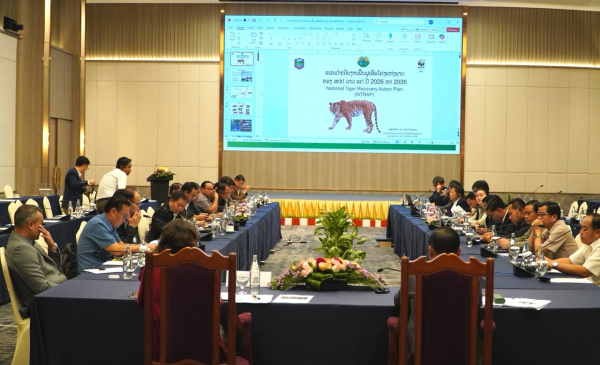
“As one of the tiger range countries, and in line with the Global Tiger Recovery Programme, the Government of Laos recognizes the importance of restoring wild tiger populations in the country,” Mr. Thoumthone said. He emphasized that recovery efforts will be pursued through priority tiger conservation landscapes, the national forest strategy, and the implementation of the National Biodiversity Strategy and Action Plan.
Globally, recent estimates suggest that around 5,700 tigers remain in the wild. Although Laos is recognized as a tiger range country, the absence of confirmed records since 2013 means it is not currently included in global population estimates. Nevertheless, conservation experts believe the country holds strong potential for recovery due to its remaining forest cover and suitable habitats.
One of the most pressing threats to tiger recovery in Laos is snaring, largely driven by the illegal wildlife trade. According to the report Silence of the Snare: Southeast Asia’s Snaring Crisis, millions of snares are estimated to be present across protected areas in Laos, Cambodia, and Viet Nam, impacting more than 700 terrestrial species. Snaring not only poses a direct threat to tigers, but also severely reduces prey populations, while habitat loss and fragmentation further undermine long-term recovery prospects.
“As top predators, tigers play a vital role in keeping forest ecosystems healthy and balanced,” said Ms. Holloway. “Their presence is a sign of a thriving forest that provides clean water, resilient landscapes, and long-term benefits for people and wildlife alike.”
Under WWF-Laos’ new five-year Strategic Plan, tigers are identified as a priority species. In alignment with the NTRAP, WWF-Laos will focus support on key landscapes such as Nam Poui National Protected Area, an ASEAN Heritage Park with high potential for tiger recovery due to its biodiversity, strategic location near Thailand, and relatively lower levels of industrial snaring.
Once approved, the collective implementation of the NTRAP is expected to restore forests, rebuild prey populations, and strengthen protection across priority landscapes. Through sustained collaboration between government, conservation partners, and local communities, Laos aims to create the conditions for wild tigers to once again roam its forests.
KPL

