KPL
Laos officially transferred responsibility for health insurance under the social security system back to the Ministry of Labour and Social Welfare on March 2, 2026, during a handover ceremony held at the National Social Security Fund (NSSF).
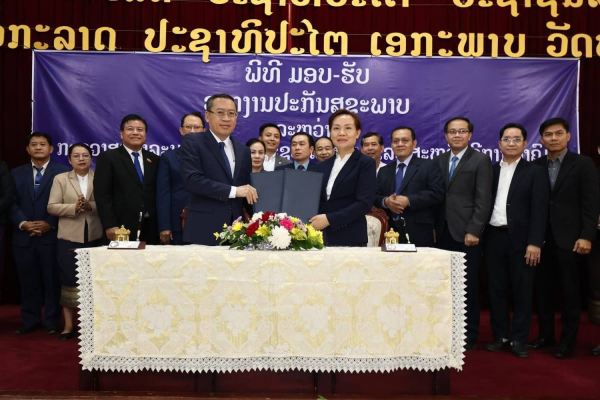
(KPL) Laos officially transferred responsibility for health insurance under the social security system back to the Ministry of Labour and Social Welfare on March 2, 2026, during a handover ceremony held at the National Social Security Fund (NSSF).
The agreement was signed by Health Minister Ms. Baykham Khattiya, representing the former administering body, and Mr. Phoxay Sayasone, Minister of Labour and Social Welfare. Senior officials from the Prime Minister’s Office, deputy ministers, department heads, hospital directors and other stakeholders attended the ceremony.
The social security system, established in 2001, operates on international principles and actuarial calculations designed to ensure long-term financial sustainability. It encourages early contributions from workers, provides protection during periods of illness, unemployment or retirement, and reduces the fiscal burden on the state through a risk-sharing mechanism.
The NSSF is funded by contributions from the government, employers, the armed forces, police, civil servants, private-sector employees and voluntary members. It is overseen by a tripartite Board of Directors representing the government, employers and employees, and operates under a dedicated accounting system approved by the Ministry of Finance.
The Fund consists of five sub-funds covering nine categories of benefits, including health insurance, occupational accident and disease coverage, short-term benefits, unemployment benefits and long-term pensions.
From 2001 to 2019, the NSSF under the Labour Ministry directly managed health insurance, contracting hospitals and allowing members to access services without out-of-pocket payments. In July 2019, the responsibility was transferred to the Health Insurance Bureau under the Ministry of Health through an official memorandum of understanding.
With the March 2026 transfer, authorities aim to streamline management and strengthen coordination within the broader social security framework.
As of the handover, the system covers 398,243 contributors, including 192,436 women. Of the total, 162,782 are public-sector employees, 190,855 are private-sector workers, and 44,606 are voluntary members. The Fund also supports 49,547 pensioners and works with 6,517 participating enterprises nationwide.
To improve efficiency and transparency, the NSSF has introduced 10 modern database systems, including contribution and registration platforms, medical eligibility verification tools, accounting and e-office systems, as well as a dedicated social security mobile application for members.
KPL

