KPL
The Lao PDR should strengthen its economic resilience by diversifying energy sources, deepening regional trade integration, and enhancing the competitiveness of domestic businesses in response to growing geopolitical and geoeconomic uncertainties, according to an expert speaking at a seminar in Vientiane.
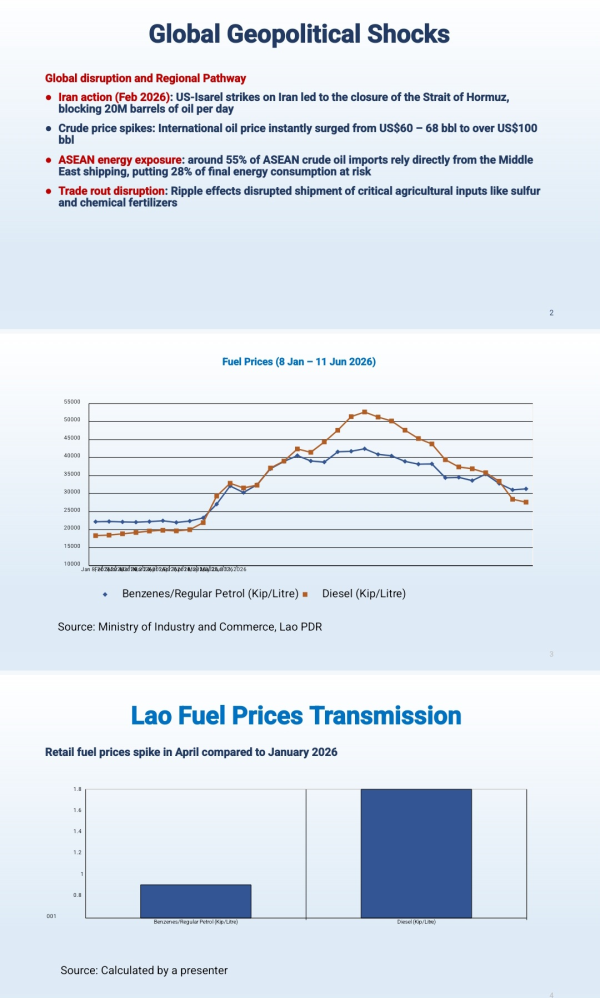
Presenting at the Seminar on Strengthening Economic Resilience amid Geoeconomic Challenges on June 17, 2026, Dr. Viengsavang Thipphavong of the Institute for Industry, Commerce and Energy under the Ministry of Industry and Commerce outlined the impact of the Middle East crisis on the Lao economy and proposed measures to mitigate future risks.
Dr. Viengsavang explained that geopolitical developments in early 2026 disrupted global energy markets after military actions involving Iran led to the closure of the Strait of Hormuz, causing international crude oil prices to surge from around US$60–68 per barrel to more than US$100 per barrel. The disruption also affected maritime trade and the supply of key agricultural inputs, including sulfur and chemical fertilizers.
He noted that Laos has long been heavily dependent on imported fuel, with more than 90 percent of its petroleum products sourced from Thailand. To reduce this dependence and strengthen energy security, the country has recently begun importing fuel from other suppliers, including Singapore and Malaysia, contributing to a slight decline in domestic fuel prices. He added that although Thailand’s temporary export restrictions created uncertainty and triggered panic buying at fuel stations earlier this year, continued bilateral cooperation helped prevent a more severe supply disruption.
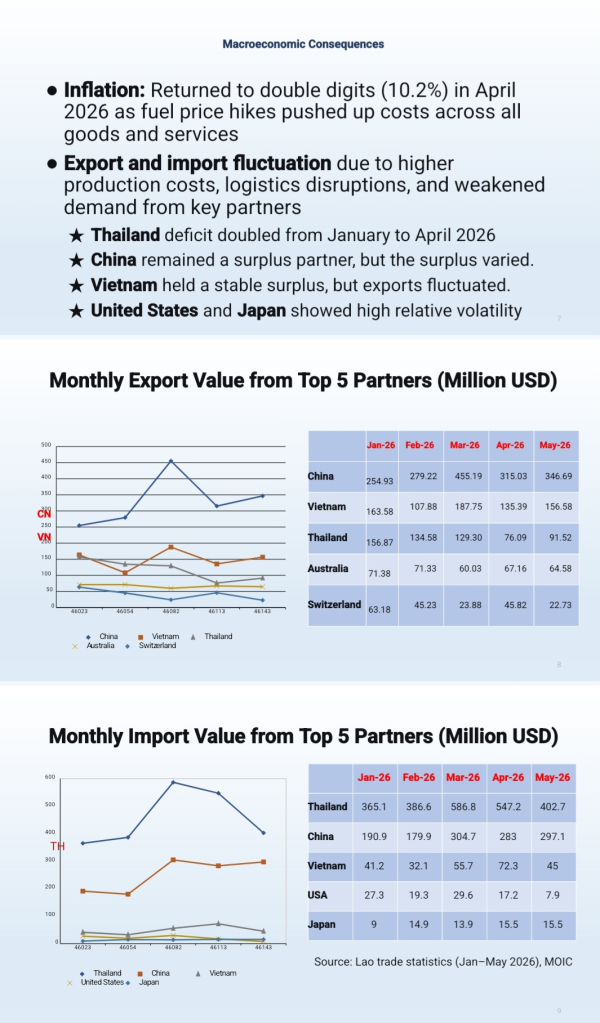
The presentation highlighted that higher fuel prices pushed inflation back into double digits, reaching 10.2 percent in April 2026, while increasing production costs, disrupting logistics, and affecting trade flows with major partners. Trade data also showed a widening deficit with Thailand during the first months of the year, while trade with China and Vietnam remained in surplus despite fluctuations.
To cushion the impact, the Lao government adopted emergency measures, including temporary reductions in fuel excise taxes, anti-hoarding regulations, restrictions on bulk fuel purchases, austerity measures for public agencies, and priority access to foreign exchange for fuel importers.
Dr. Viengsavang also emphasized the need to make better use of the Regional Comprehensive Economic Partnership (RCEP), noting that only a small number of Lao enterprises actively utilize the agreement despite increasing issuance of RCEP certificates. He recommended establishing an RCEP help desk, expanding technical cooperation, and identifying export products with greater potential to benefit from preferential market access.
For the medium term, he proposed streamlining regional transit procedures, reducing border clearance times, further diversifying petroleum import sources, and promoting exports of products such as potash, coffee, cassava, sugar, and rubber.
Long-term priorities include accelerating electric vehicle adoption, leveraging updated regional trade frameworks such as ACFTA 3.0 and RCEP, and advancing the country’s Land-Linked Strategy through the Laos–China Railway and related logistics infrastructure.
Dr. Viengsavang concluded that strengthening energy security, expanding regional economic integration, and improving the competitiveness of Lao enterprises will be essential to building a more resilient economy capable of withstanding future geopolitical and geoeconomic shocks.
KPL

