KPL
More than 2,000 young people and community members across Bokeo Province have significantly strengthened their resilience to climate change following the successful completion of a three-year Climate Change Adaptation (CCA) Project in Paktha and Pha Oudom districts.
.jpeg)
Plan International Laos, in partnership with the Maeying Huamchai Phatthana (MHP) Association and the Lao Government, today marked the completion of the initiative, titled Climate Change Adaptation in Upland Areas through Innovative Practices. Launched in August 2023, the project has delivered sustainable, long-term solutions to some of the region’s most remote and vulnerable communities.
The initiative was specifically designed to empower young women and men with practical skills, diversify rural livelihoods, and introduce sustainable agricultural and infrastructure solutions tailored to local conditions.
“We do not simply work with communities and leave them to face an uncertain future,” said Carol Mortensen, Country Director of Plan International Laos. “Instead, we have established Community Innovative Learning Centres where community members can seek advice, learn, and observe agricultural and livestock practices directly from technical staff. Climate change is a global crisis, but it has immediate and severe impacts on rural populations, particularly the most vulnerable.”
Central to the project’s success was the construction of two fully equipped Community Innovative and Learning Centres (CILCs), which serve as permanent hubs for technical support and practical demonstrations. Through hands-on training at these centres, local youth have developed expertise in innovative climate-smart practices, including small-scale aquaculture, poultry production, and alternative cash-crop farming, creating valuable income-generating opportunities for rural families.
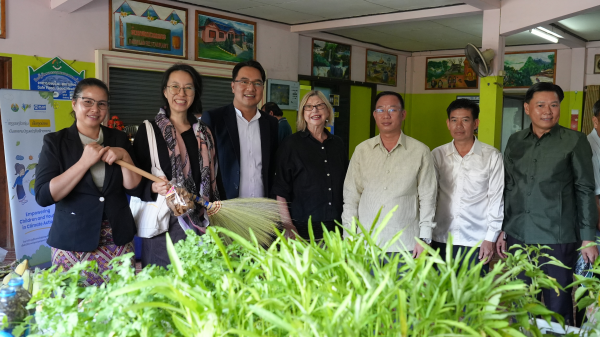
“Rather than waiting for opportunities to come my way, I decided to pursue my ambitions by expanding my agricultural knowledge and skills at the CILC,” said Kia, one of the technical staff members at the Houaymong Centre. “We have to show others that what we are doing works. Raising frogs is an excellent example that inspires young people to start small enterprises at home.”
Beyond agricultural training, the project also partnered with lower secondary schools to address the wider climate and disaster risks threatening children’s lives and education.
“Worldwide, 875 million schoolchildren live in high seismic-risk zones, and hundreds of millions more face regular floods, landslides, extreme winds, and fire hazards,” Ms Mortensen added. “Children spend up to half of their waking hours in school facilities, yet they are rarely taught how to become disaster resilient. This gap compromises their fundamental right to access life-saving information on climate impacts and resilience.”
To address this issue, the CCA Project worked directly with young people, particularly young women and men, as well as farming families, to strengthen their agricultural, livestock, and leadership skills. By providing small grants, establishing income-generation groups, and installing solar-powered wells and water towers, the initiative ensured that local communities were not only informed, but also fully equipped to cope with climate-related shocks.
The practical impact of these interventions is already evident, with targeted households recording an average 28 per cent increase in income after adopting the project’s sustainable practices. This economic improvement demonstrates that when young people are provided with the necessary tools and resources, rural communities can successfully overcome escalating climate challenges year after year. Through this model, Plan International Laos continues to support young people, especially girls, in leading the transition towards a safer and more sustainable future.
The project was funded by Plan International Germany with generous support from the German public. It was implemented in close collaboration with Plan International Laos, the MHP Association, and the District Agriculture and Environment Offices of Paktha and Pha Oudom, under the guidance of the Bokeo Provincial Department of Agriculture and Forestry and the Ministry of Agriculture and Forestry.
KPL

