KPL
A delegation led by, Mr. Vongphet Oudomlit, Director General of the Research Institute for Educational Sciences (RIES), Ministry of Education and Sports (MoES) and Michael Currie, First Secretary, Australian Embassy, visited LuangNamtha province from 27 to 29 April to learn about the implementation of grade 1 Spoken Lao. The visit also showcased how school-based continuing professional development (CPD) helps teachers implement Spoken Lao and support students who speak a language other than Lao at home to be more engaged and learn at school.
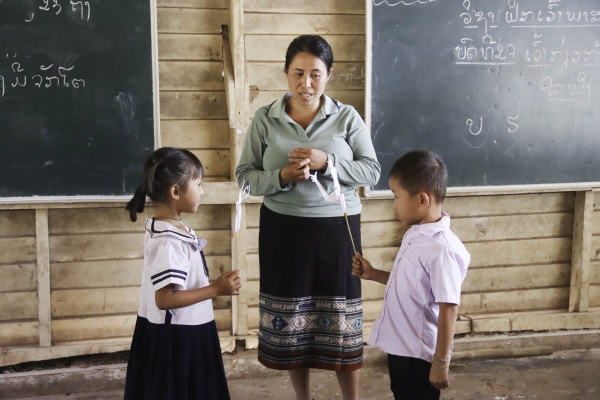
Students use handmade puppets to practice conversation in Spoken Lao lesson.
The delegation included representatives from the Lao Language Research Centre of RIES, the Department of Planning, the Department of Teacher Education, the Primary Division and Inclusive Education Division of the Department of General Education, the Australian Embassy and BEQUAL experts.
During the visit, the delegation observed Spoken Lao lessons in several primary schools and met with teachers, principals, internal and external pedagogical support (IPS and EPS) staff, district and provincial education staff and technical and core teams from the Teacher Training College. They discussed the progress and challenges of the program, as well as the support that schools and teachers need to keep improving learning outcomes for young children.
Spoken Lao is designed to help children who start school without being able to speak Lao well. Spoken Lao lessons are additional, but work alongside, the Lao Language lessons in the grade 1 curriculum. They are taught in the afternoon for at least three days per week, and each of the 30 lessons aligns with the 30 Lao Language lessons. The lessons give children extra time and support to build their Lao language skills so they can understand their teachers, join classroom activities, and learn other subjects more easily. Spoken Lao lessons are an important part of efforts to make learning more inclusive for children from diverse language backgrounds.
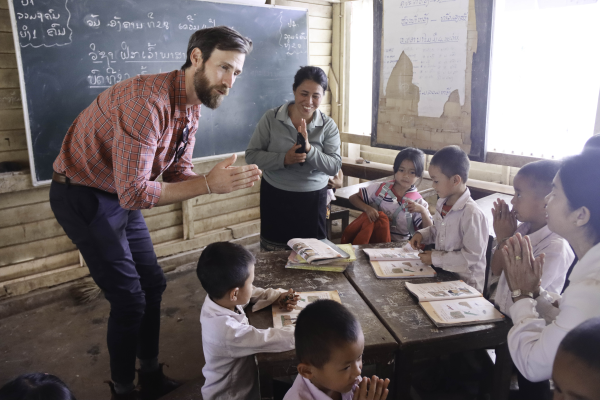
Mr Michael Currie, First Secreatry of Australian Embassy, envourages young students to continue learning.
The approach was first trialled in several provinces and after strong results was introduced nationally in the 2024–2025 school year. It is now helping grade 1 students in schools across all provinces where many children need extra support to learn Lao language skills at the start of their education.
“MoES and Australia have worked closely together through the BEQUAL program to strengthen Lao language learning for children who begin school speaking a different language at home. Spoken Lao was tested in several provinces before being expanded nationally in the 2024–2025 school year. What we saw in the classroom showed how the lessons help children speak more confidently, understand better, and take part more actively in learning. Based on the success of grade 1 implementation, MoES is now developing grade 2 lessons with Australian Government support. Lessons learned from Grade 1 are being used to make the new materials easier for teachers to use and more effective for students. The materials will be ready for use in the 2027-2028 school year,” said Mr. Vongphet Oudomlit.
“Improving learning outcomes for children who enter primary school not able to speak the language of instruction is a significant equity issue. It is estimated that 40% of students have home languages other than Lao. Spoken Lao shows how a successful pilot can grow into a practical nationwide approach that supports inclusive education. Australia is proud to work with MoES on this important effort. When children gain strong language skills early, they are better able to participate and succeed at school,” said Michael Currie, First Secretary at the Australian Embassy.
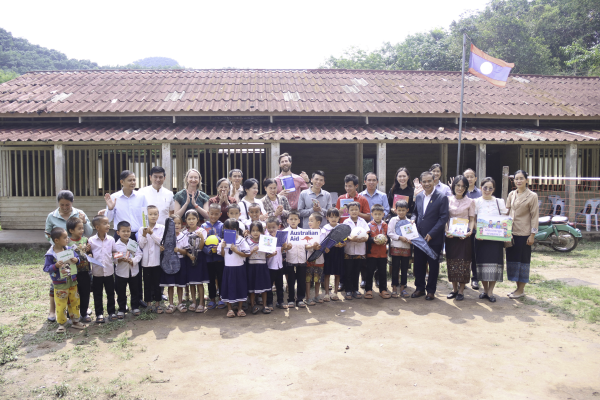
Children were happy to receive learning materials and sports equipment from the delegation.
The visit also highlighted the support teachers receive to help them use Spoken Lao effectively. The delegation discussed how school-level IPS providers, in collaboration with TTCs and DESB, offer regular, practical and tailored CPD support to teachers. This support takes place through several different approaches including classroom observations, formal and informal discussions, co-teaching, remote check-ins and WhatsApp messaging, often using resources such as Teacher Support Pack modules and Teacher Development Videos for technical content and advice. Support is adapted to each teacher’s needs, from lesson planning to use of materials and classroom delivery, so teachers can apply new skills immediately. These forms of support help teachers build confidence and respond better to the different learning needs in their classrooms.
“The delegation heard from teachers and pedagogical support providers that practical, regular support makes a real difference in day-to-day teaching. It helps teachers improve their skills, strengthen classroom practice, and better support students, especially those with learning difficulties. When teachers are supported well, they become more confident and effective. This helps all students, especially children who need extra language support at the start of school,” said Mr. Vongphet Oudomlit.
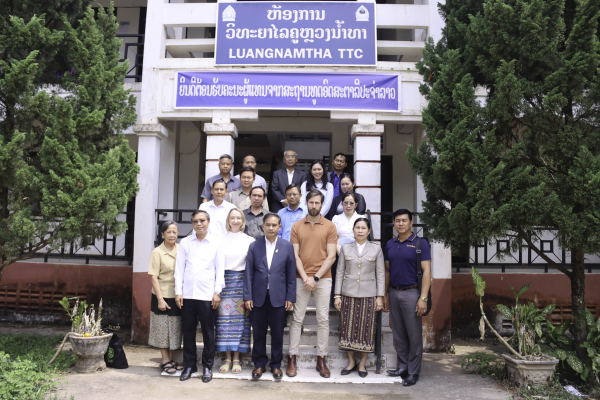
MoES and Australian Embassy delegation visited LuangNamtha TTC to discuss implementation of Spoken Lao and teacher support.
“Australia is proud to support MoES in building a system that helps teachers continue learning and improving. The progress we saw in Luang Namtha reminds us that quality basic education starts with well-supported teachers, and that ensuring every child has access to a quality learning experience remains one of the most critical investments we can make in the future of the Lao PDR,” Michael Currie added.
The visit reinforced the shared commitment of the Governments of Lao PDR and Australia to support inclusive education and give more children the chance to succeed at school. Both governments agree that education is an investment with significant returns that benefit children, communities and the nation.
KPL

