KPL
On March 18, 2026, the Government of Laos enacted sweeping emergency measures to curb rising fuel costs, introducing tax reductions and price controls aimed at stabilizing the energy market and easing mounting inflationary pressure.
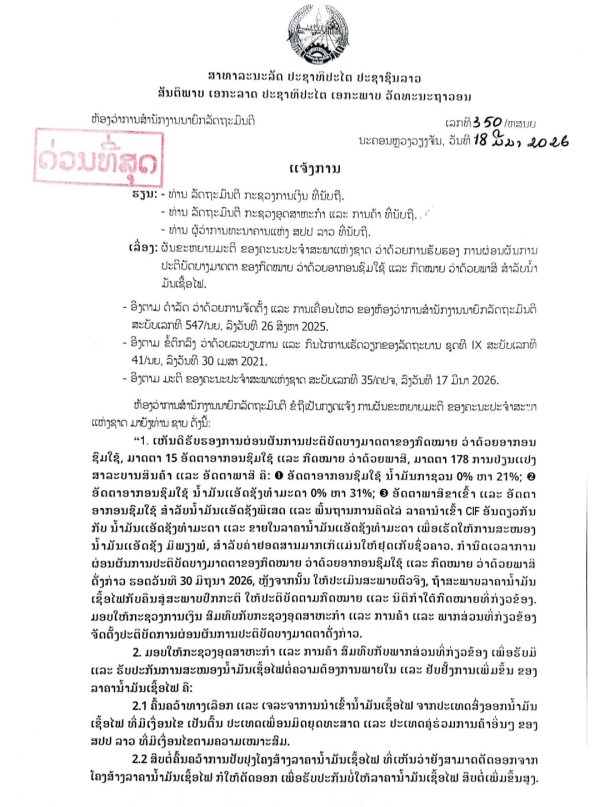
(KPL) On March 18, 2026, the Government of Laos enacted sweeping emergency measures to curb rising fuel costs, introducing tax reductions and price controls aimed at stabilizing the energy market and easing mounting inflationary pressure.
The directive, issued by the Prime Minister’s Office, formalizes the implementation of a resolution adopted by the National Assembly Standing Committee, with immediate nationwide effect.
At the core of the policy is a temporary restructuring of fuel taxation and pricing. Authorities have adjusted excise tax ceilings—capped at 21 percent for diesel and 31 percent for regular gasoline—while mandating that premium gasoline be taxed and sold at the same rate as regular fuel. The government has also suspended the collection of marker chemical additive fees, further reducing retail prices.
The measures are set to remain in place until June 30, 2026, pending a comprehensive reassessment of global oil market conditions and domestic economic indicators.
The Ministry of Industry and Commerce has been assigned a central role in enforcing the policy, including securing fuel imports under more favorable terms and conducting a review of the current pricing structure to eliminate unnecessary cost components.
Beyond immediate interventions, the government is advancing longer-term strategies to strengthen energy resilience. These include studying the feasibility of fuel subsidies and accelerating the transition toward electric vehicles to reduce dependence on imported petroleum.
The directive also calls for demand-side measures, encouraging increased use of digital communication and remote working arrangements to help lower national fuel consumption.
Officials underscored that the policy is designed to contain broader economic spillover effects, particularly rising costs of goods and services. Key institutions, including the Ministry of Finance and the Bank of the Lao PDR, have been instructed to intensify monitoring of market dynamics and respond proactively to emerging risks.
The move highlights growing concern within the government over persistent inflationary pressures affecting households and businesses, especially in Vientiane and other urban centers, as global energy volatility continues to impact the domestic economy.
KPL

