KPL
On January 13, 2026, Mr. Alounxay Sounnalath, Member of the Party Central Committee and Secretary of the Champasak Provincial Party Committee, together with his delegation, attended a religious almsgiving ceremony held during the annual Manikhoth Tree Festival at the Manikhoth Tree Shrine, within the Khone Phapheng Waterfalls tourist site, Khong District, Champasak Province.
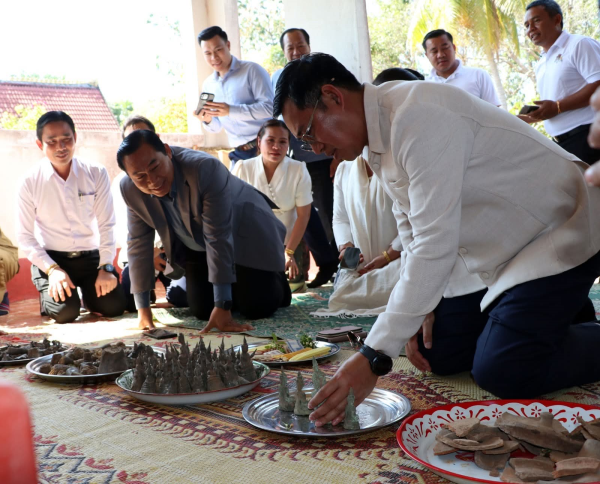
(KPL) On January 13, 2026, Mr. Alounxay Sounnalath, Member of the Party Central Committee and Secretary of the Champasak Provincial Party Committee, together with his delegation, attended a religious almsgiving ceremony held during the annual Manikhoth Tree Festival at the Manikhoth Tree Shrine, within the Khone Phapheng Waterfalls tourist site, Khong District, Champasak Province.
Following the ceremony, the delegation visited Ban Vernkhao, Hadsaykhoun village group, to inspect ancient Buddha images recently discovered on January 11, 2026.
During the visit, Mr. Alounxay Sounnalath stated that the discovery of the sacred Buddha images is of great historical and spiritual significance, reflecting the cultural richness and deep-rooted Buddhist civilization of the area. He emphasized that the finely crafted images demonstrate the strong faith of ancestors and serve as clear evidence that the region was once a prosperous center of spiritual and cultural development.
The provincial leadership instructed relevant district authorities to urgently develop plans for the proper preservation and safeguarding of the artifacts, document the history of the discovery for public display, and consider appropriate policies and recognition for the family that discovered the Buddha images.
On the same day, Mr. Somphathai Ketmala from the Champasak Provincial Department of Information, Culture and Tourism led a team of specialists to conduct a preliminary technical inspection and data collection.
Initial expert findings indicate that a total of 105 Buddha images were recovered. The images are made of Pha Keson Dokmai and depict the Maravijaya posture, symbolizing the Victory over Mara. Experts estimate the images date back to the 17th–18th century, approximately 400 years ago.
According to specialists, the images were likely created as votive offerings to fulfill spiritual vows. The images were found stored in a clay jar buried underground, a traditional practice intended to entrust sacred objects to the earth for long-term preservation and to protect them from damage or theft during periods of conflict.
KPL

