KPL
The Food and Agriculture Organization of the United Nations (FAO) and the Lao PDR government are convening stakeholders to unlock the potential of the country's chili pepper sector for international markets and sustainable investment.
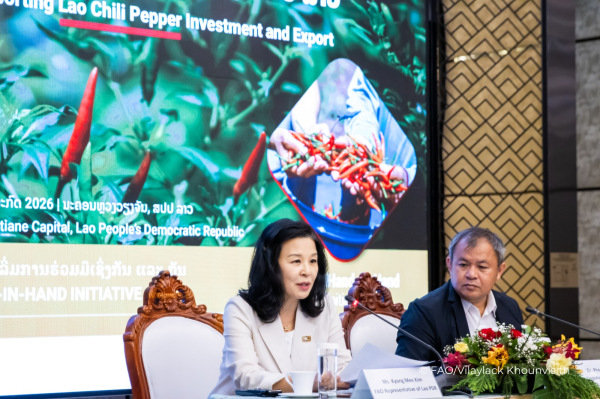
The Food and Agriculture Organization of the United Nations (FAO) and the Lao PDR government are convening stakeholders to unlock the potential of the country's chili pepper sector for international markets and sustainable investment.
This work is carried out under FAO's Hand-in-Hand Initiative to promote agriculture investment into the country.
Chili pepper is recognized as one of several priority commodities under the FAO Global Hand-in-Hand Initiative (HiHI) in the Lao PDR.
The initiative aims to increase smallholder incomes and enhance value addition by strengthening the chili value chain, improving market access, and attracting investment for export-oriented production. Internationally, Lao chili pepper attracted concrete interest from buyers and investors, including those from China and the Republic of Korea, at the HiHI Global Investment Forum 2025 in Rome.
“Chili pepper holds significant potential for both domestic and international market and it has already attracted concrete interest from buyers and investors,” said Dr. Phommy Inthichack, Deputy Director General of Planning and Cooperation of the Ministry of Agriculture and Environment (MAE).
“FAO’s role, through the HiH Initiative, is to support the Lao PDR in transforming that potential into reality by providing technical assistance, strengthening analytical capacity, and facilitating linkages with international markets and investors,” said FAO Representative in the Lao PDR Kyung-Mee Kim.
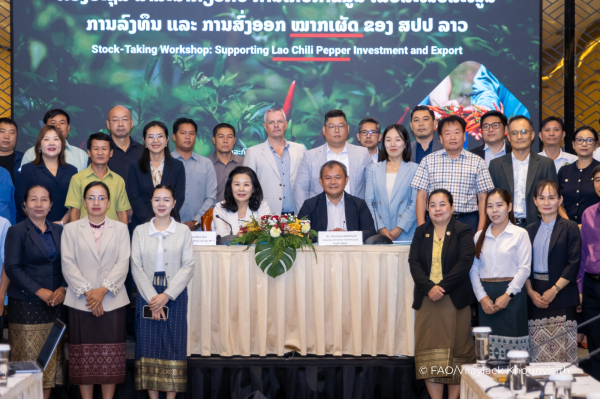
Stock-Taking Workshop brings together approximately 70 participants from the central and provincial government agencies, research institutions, producer organizations, and the private sector. The event focuses on validating findings from a recent Stock-Taking Survey and Value Chain Analysis conducted in May and June 2026.
FAO’s Hand-in-Hand team presented up-to-date chili production data in main provinces and districts, current production practices, farm gate prices, production cost, the chili pepper value chain linkages, and key stakeholders involved.
They also shared market information that China and the Republic of Korea both have structural import demand for chili products, but require different export strategies for the Lao PDR: China is now a net importer of dried chili and offers 0% tariff access for Lao products, while Korea imports over 70% of its consumption but high tariffs make frozen or processed chili the most viable entry route.
It was recommended that dried and processing-grade chili for China and frozen/minced chili for Korea, while prioritizing compliance, SPS requirements, traceability, cold-chain infrastructure, and aggregation systems as the key factors needed to convert market opportunities into exports.
It was agreed that Lao PDR’s chilli sector has strong potential to transition from a household crop to a commercial value chain, driven by growing domestic demand, export opportunities (especially to China, Korea and ASEAN market), and attractive investment returns under a cooperative-based production model.
Also, FAO’s analysis highlights key constraints including dependence on imported inputs, post-harvest losses, climate risks, and SPS compliance requirements.
Overcoming the export challenges requires priority actions, such as compliance with market access requirements (registration, food safety standards, phytosanitary protocols), as well as investment in supply-side readiness (primary processing, cold-chain facilities, aggregation, traceability, and consistent quality control).
In short, the main constraint is not demand but readiness to supply export-quality products consistently, supported by infrastructure, food safety compliance, and efficient producer organization.
Stakeholders at the workshop agreed on a prioritized gap-closing action plan. The validated data will then directly underpin the Lao Chili Pepper Investment Brief.
This document will serve as the evidence base for an upcoming Business Matching Event scheduled for August 2026, which aims to connect Lao supply-side actors with verified international buyers and investors.
KPL

