KPL
Prime Minister Sonexay Siphandone has called on the Ministry of Finance to accelerate comprehensive modernization of the finance sector to strengthen revenue collection and improve budget expenditure management at both central and local levels.
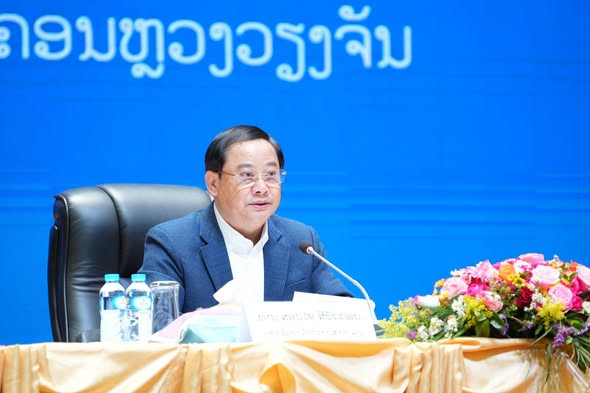
(KPL) Prime Minister Sonexay Siphandone has called on the Ministry of Finance to accelerate comprehensive modernization of the finance sector to strengthen revenue collection and improve budget expenditure management at both central and local levels.
The call was made during the National Finance Sector Review Meeting for 2025 and the 2026 Work Direction, held on January 30, 2026.
The Prime Minister emphasized the need to centralize, accurately record, and fully manage state revenues and expenditures, while fast-tracking the integration of revenue management systems with relevant sectors nationwide.
Expanding Digital Finance Systems
Priority was placed on expanding the electronic invoice system to businesses nationwide and rolling out electronic filing and digital budget disbursement systems (D-Filing) across government agencies. These systems will be used to collect fees, service charges, and funds, including at international border checkpoints, with centralized collection through the Ministry of Finance’s FinPass system.
Discipline, Ethics, and Institutional Reform
The Prime Minister also stressed the importance of political and ethical training for finance personnel, calling for loyalty, integrity, professionalism, and strict adherence to fiscal discipline.
He urged the finance sector to improve organizational efficiency following the merger of two ministries, and to translate Resolution No. 04 of the Party Politburo on building an independent, self-reliant economy into concrete action.
Supporting Growth Targets and Fiscal Balance
The finance sector was instructed to play a central role in promoting economic growth, with a target of 5.5 percent GDP growth in 2026, and an average growth rate of 6 percent or higher during 2026–2030.
Budget revenue is required to reach at least 20 percent of GDP in 2026, through expansion of the domestic revenue base, including adjustments to tax rates, natural resource-related fees, excise taxes on luxury goods, and transit transport charges.
Budget expenditure management must continue to improve through modern approval and disbursement systems to ensure transparency and efficiency.
Investment Focus and Public Debt Management
State investment planning must align with sectoral priorities, emphasizing regional development, poverty reduction, and connectivity projects such as roads to production areas, tourism sites, and key economic corridors.
The Prime Minister also called for tighter public debt management, including improved loan monitoring, avoidance of ineffective and high-interest borrowing, and continued negotiations to restructure public debt.
State Enterprise Reform and Statistics Development
State-owned enterprises were urged to accelerate reform to become profitable and contribute at least 1 percent of GDP to the state budget, with long-term potential to enter the Lao Securities Exchange.
He further directed the acceleration of the 5th Population and Housing Census results, alongside improvements in economic and statistical surveys to support policy formulation and expand the revenue base.
Strengthening Oversight and Anti-Corruption Measures
The Prime Minister concluded by stressing the need to strengthen fiscal legislation, enhance inspection and audit mechanisms, and intensify anti-corruption measures to prevent budget leakage and public debt risks at all levels.
KPL

