KPL
The Lao PDR on September 21 officially launched the National Agenda for Rural Development and Poverty Eradication (2027–2030), setting targets to reduce poverty, improve rural infrastructure and services, create jobs and raise living standards in rural communities.
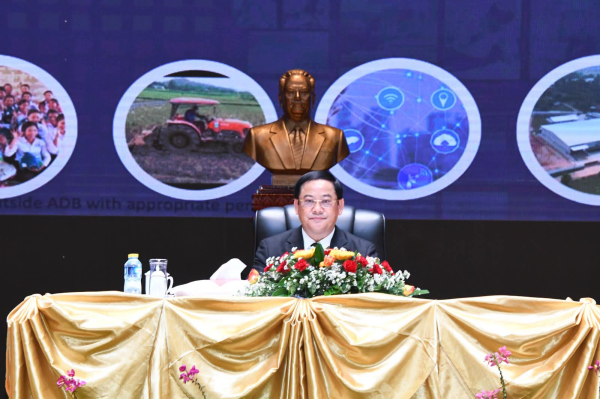
(KPL) The high-level meeting at the National Convention Hall was chaired by Prime Minister Sonexay Siphandone and attended by deputy prime ministers, ministers and deputy ministers, provincial governors, local authorities and representatives from relevant sectors.
Presenting the agenda, Dr. Linkham Douangsavanh, Minister of Agriculture and Environment, said it translates key Party and State resolutions into concrete actions, including the resolutions of the 12th National Congress of the Lao People’s Revolutionary Party, the 10th National Socio-Economic Development Plan (2026–2030), Central Party Resolution No. 62, and National Assembly Resolutions No. 34 and No. 19.
The agenda aims to mobilise resources nationwide to reduce poverty, develop rural infrastructure and improve people’s living conditions. From 2027 to 2030, the government plans to lift more than 100,000 families out of poverty and reduce the national poverty rate to a single-digit level.
It also targets lifting more than 1,000 villages and 25 districts out of poverty status and establishing at least four to five model focal villages in each province.
Priority areas include job creation, social protection, rural infrastructure, permanent settlement development and stronger grassroots administration.
Prime Minister Sonexay identified rural development and poverty eradication as major national priorities, linking the agenda to the Party-State’s Three Builds policy and the United Nations Sustainable Development Goals.
According to figures presented at the meeting, Laos currently has 189,792 impoverished families, or 14.78%, as well as 2,173 impoverished villages and 66 impoverished districts.
To address these challenges, the Prime Minister outlined five priority areas.
The first is agricultural modernisation, including a shift from subsistence farming towards commercial production, stronger farming groups and cooperatives, improved access to affordable financing and markets, and greater development of local processing.
The second is rural infrastructure, with efforts to accelerate the construction and repair of all-weather roads and expand electricity, clean water and telecommunications services.
The third is human capital development, focusing on reducing school dropout rates, encouraging doctors and teachers to work in remote areas, and improving early childhood nutrition.
The fourth is grassroots administration, including strengthening local capacity, delegating appropriate authority and budgets, and deploying officials to work directly with rural communities to address local challenges.
The fifth is land management and safety, including accelerating land surveying, zoning and land-title issuance, while intensifying UXO clearance in agricultural areas to improve public safety and support rural development.
Prime Minister Sonexay stressed that poverty eradication is a shared responsibility involving the political system, armed forces, government agencies, local authorities and society as a whole. He called on all sectors to incorporate the national agenda into their respective operational plans.
Under the implementation arrangements, the Prime Minister’s Office will serve as the central coordinating body, while the Ministry of Agriculture and Environment will lead monitoring, evaluation and plan consolidation. The Ministry of Finance will oversee budget allocation.
Line ministries, agencies and local authorities have been instructed to complete detailed action plans by October 2026 for submission to the National Assembly for approval by the end of the year. The agenda is scheduled to begin official implementation in January 2027.
KPL

