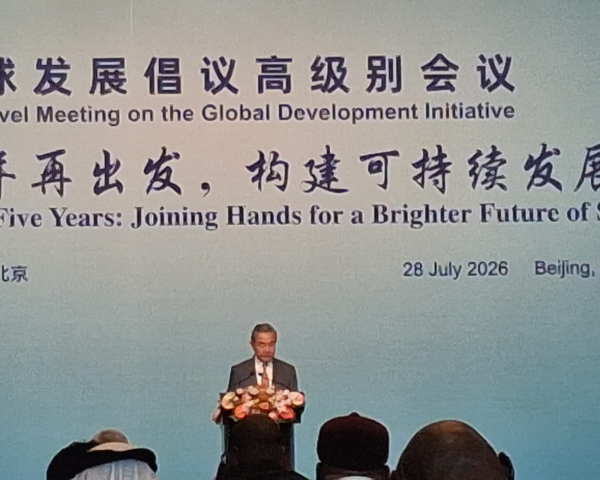
The meeting focused on forging stronger partnerships to accelerate sustainable development worldwide amid a complex global economic and geopolitical landscape.
The high-level dialogue brought together key figures, including Chinese Foreign Minister Wang Yi and Mr. Earle Courtenay Rattray, Chef de Cabinet to the UN Secretary-General, to evaluate the initiative’s transformative journey from a conceptual vision into a driving force for global progress.
Translating Vision into Results
First proposed by Chinese President Xi Jinping during the 76th Session of the United Nations General Assembly, the GDI has evolved into a pivotal framework for international cooperation.
Addressing the gathering, Chinese Foreign Minister Wang Yi emphasized that over the past half-decade, the initiative has successfully bridged policy frameworks and practical implementation.
Expanding Global Reach: The Group of Friends of the GDI has expanded to include more than 80 member states, while the UN Task Force on the Promotion of the Initiative has integrated over 20 development agencies.
Financial and Project Milestones: Backed by the China-UN Peace and Development Fund and the Global Development and South-South Cooperation Fund, the initiative has leveraged more than US$23 billion in funding to execute over 1,800 practical cooperation projects.
Capacity Building: More than 200,000 personnel across various sectors have received specialized training.
Environmental and Technological Impact: Green development outcomes have directly benefited over 120 countries, supported by critical infrastructure such as meteorological early-warning platforms for the Global South.
"Facing an uncertain world, we have no reason to retreat, nor will we stagnate," Wang stated, highlighting China's steady economic growth—recording over 5.4% in the first half of the year—as evidence of its commitment to remaining a reliable partner in global development.
Four Key Proposals for the Future
To navigate ongoing global hurdles—including widening North-South gaps, geopolitical tensions, and severe disruptions to the 2030 Agenda—Wang put forward a four-point cooperative strategy:
1. Strengthen Unity and Cooperation: Uphold the UN-centred international system and foster a stable environment for peaceful development.
2. Accelerate 2030 Agenda Implementation: Prioritize development on the global agenda, scale up resource investments, and expand bilateral, multilateral, and trilateral cooperation.
3. Expand Innovative and Open Development: Eliminate digital and intelligent divides. Wang pointed to the recent launch of the "World Artificial Intelligence Cooperation Initiative"—co-initiated by China and 28 other countries—as a major step forward in AI governance for the Global South.
4. Practice Multilateralism and Reform Governance: Reshape global financial and economic systems to better address the needs of developing nations, while preparing groundwork for the post-2030 global development agenda slated for discussion ahead of September 2027.
A Call for Scale and Financing
Speaking on behalf of the United Nations, Mr. Earle Courtenay Rattray lauded the GDI's tangible local impacts, noting that its projects—ranging from school meal programmes to fiber-optic networks and climate early-warning systems—have directly bettered millions of lives across more than 60 countries.
Drawing parallels to China’s historic socio-economic transformation, which lifted 800 million people out of poverty, Rattray emphasized that the nation’s technological leadership—particularly in clean energy, where China accounted for 60% of global renewable capacity growth last year—serves as a blueprint for sustainable modernization.
However, Rattray issued a sobering reminder regarding the wider state of global targets:
The SDG Gap: With only 36% of measurable SDG targets currently on track, the annual financing gap now exceeds US$4 trillion.
Systemic Hurdles: Many developing nations continue to spend more on debt servicing than on health and education combined, compounded by a recent 23% single-year drop in official development assistance.
Rattray underscored three critical pillars where collaborative leadership remains essential: innovative financing architectures, accessible green and digital technologies (including AI integration), and strategic preparation for the post-2030 development framework.
Looking Ahead
As the international community counts down the final years toward the 2030 deadline, leaders at the Beijing meeting stressed that solutions and partnerships already exist. The collective mandate moving forward relies on political will, solidarity, and targeted resource mobilization to transform global development ambitions into lasting realities.

