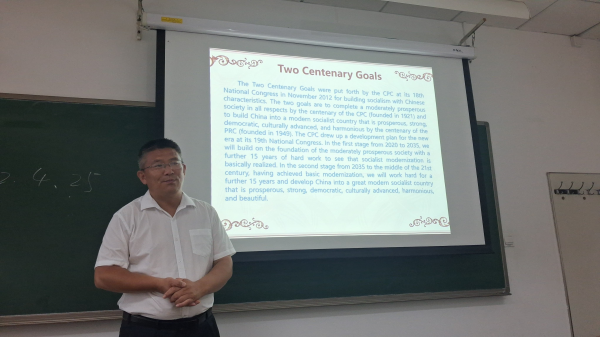
This was the core message delivered by Mr Lu Keli, Associate Professor at the Department of Scientific Socialism within the School of Marxism Studies at Renmin University of China, during a thematic lecture in Beijing on July 28.
The lecture mapped out how China’s modernization drive has evolved through decades of strategic policy formulation, highlighting its institutional architecture, historical milestones, and future trajectory toward the middle of the 21st century. The Evolution of the Five-Sphere Integrated Plan
Professor Lu emphasized that China's overarching blueprint for development has expanded incrementally over the decades to meet the demands of a changing society:
From Two to Five Spheres: Initial planning focused on a smaller footprint, evolving through three-in-one and four-in-one frameworks before culminating in the Five-Sphere Integrated Plan at the 18th National Congress of the Communist Party of China (CPC) in November 2012.
The Core Pillars: The plan encompasses economic, political, cultural, social, and ecological advancement.
Coordinated Development: While economic growth remains the central pillar, all five spheres are promoted in a coordinated manner. Together, they foster a socialist market economy, democratic governance, advanced culture, ecological progress, and a harmonious society aimed at making the people more prosperous, the country stronger, and China more beautiful.
Two Versions of the Four-Pronged Comprehensive Strategy
A vital takeaway from the lecture is how the strategic framework supporting this vision has adapted, moving from its initial goal-oriented setup to a modernized iteration:
The First Version: Centred around completing a moderately prosperous society in all respects—the first Centenary Goal, which was successfully achieved by 2020 (marking the 100th anniversary of the founding of the CPC in 1921)—alongside reform, the rule of law, and party discipline.
The New Version: With the first milestone reached, the strategic focus has transitioned toward building a modern socialist country. Under this updated framework, the interrelationship is clear: building a modern socialist country serves as the ultimate goal, while deepening reform, advancing law-based governance, and strengthening Party self-governance act as the strategic measures to achieve it.
Timeline of the Two Centenary Goals
Detailing the roadmap to national rejuvenation, the lecture highlighted the phased timeline set for socialist modernization:
Stage One (2020–2035): Building upon the foundation of a moderately prosperous society with 15 years of hard work to basically realize socialist modernization.
Stage Two (2035–Mid-21st Century): Following basic modernization, working for another 15 years to develop China into a great modern socialist country that is prosperous, strong, democratic, culturally advanced, harmonious, and beautiful by the centenary of China.
Defining Socialism with Chinese Characteristics in 10 Points.
Drawing from the sixth plenum of the seventh committee, Professor Lu outlined the ten definitive dimensions that shape the future of Chinese socialism:
1. Ultimate Future: Advancing toward communism.
2. Core Goals: National modernization and national rejuvenation.
3. People-Centric Philosophy: Delivering welfare and prioritizing the people.
4. Strategic Framework: Implementing the Five-Sphere Plan and the Four-Pronged Strategy.
5 & 6. Reform and Rule of Law: Deepening reform and advancing law-based governance.
7. Economic System: Operating a socialist market economy characterized by high-quality development, the new development philosophy (innovative, coordinated, green, open, and shared), and support for the private sector.
8. National Defense: Building a strong, world-class military.
9. Foreign Policy: Pursuing major-country diplomacy.
10. Party Governance: Maintaining rigorous and sound governance of the CPC, which currently boasts a membership exceeding 100 million.

