KPL
High in the misty mountains of Bokeo Province in northern Laos lives Morm, a 38-year-old father of two. He shares a tall wooden house with his wife and ageing parents. His two sons, who completed lower secondary school, now work at a barbershop and a motorcycle repair shop in a town in the centre of Bokeo Province. Like most families in his community, Morm and his family depend on the weather for their rice farming and small cash-crop cultivation.
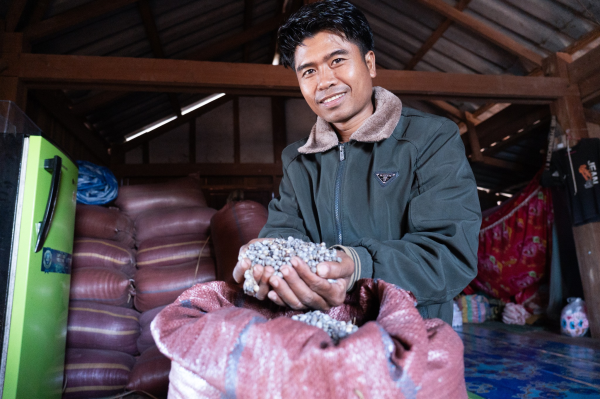
Last year, Morm traded around two tonnes of Job's Tears and earned a small profit. ©Plan International Laos.
In late 2024, a flash flood tore through Morm’s lowland paddy field, wiping out his family’s single hectare of rice—one of their primary sources of food—and killing several of his cattle. Combined with a drought earlier that year, the disaster left the household in a precarious economic position.
Although Morm also manages three hectares of highland rice cultivation, he says production there is increasingly at risk. Yields are declining due to soil degradation, drastic weather shifts, and frequent natural disasters. Furthermore, many people in the area continue to practice slash-and-burn agriculture, leading to significant forest loss. This deforestation directly threatens Morm’s highland crops by destabilising the local ecosystem.
“Relying only on rice cultivation is a risk to our livelihoods because the weather is unpredictable,” said Morm.
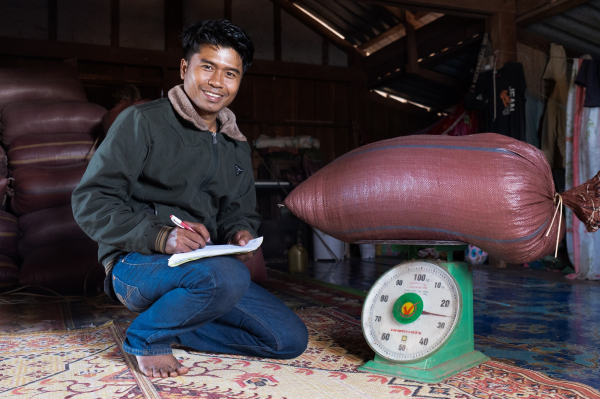
Morm with his light-coloured Job's Tears. Dark colour ones have harder shells and are used to produce beads and jewellery, while the light-coloured ones are soft-shelled and processed for food and traditional medicine. ©Plan International Laos.
To adapt to climate change impacts—including unpredictable weather, floods, and droughts—and to find new sources of income, Morm began trading cattle and rice. He sold two of his remaining buffaloes to purchase rice, then bought additional stock from neighbours to resell for a modest profit. This helped him earn enough income to survive the most difficult months. He also raises a few pigs, poultry, and goats for his family’s consumption or to sell when necessary.
Around this time, Morm joined income-generation activities at the Community Innovative Learning Centre (CILC) in Pha Oudom District. The centre is supported by Plan International Germany, Plan International Laos, and the Maeying Huamchai Phatthan (MHP) Association. Community technical facilitators trained him in climate-resilient livelihoods and introduced him to alternative crops that require far less water, such as broom grass, rattan, Job’s Tears (Coix lacryma-jobi), Inca-star beans, and hydroponic vegetables. Among these, Morm identified broom grass and Job’s Tears—used for jewellery, food, and traditional medicine—as crops that could grow well on his highland plots.
Morm also received a small grant from the climate change adaptation (CCA) project to invest in Job’s Tears cultivation, while using his own earnings to expand into broom grass production.
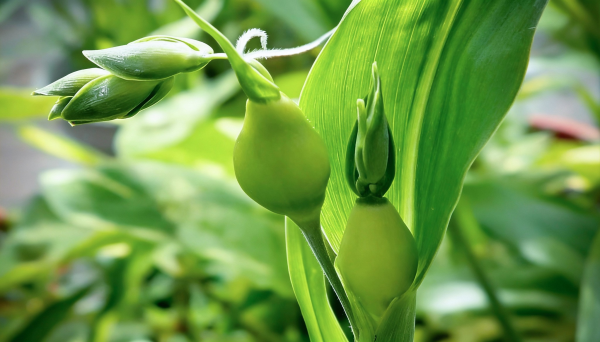
Young Job's Tear fruits are yellowish or greenish when they are young and they will turn to dark or light colour once they're ripe. ©Plan International Laos
By mid-2025, the results of these efforts became clear. His Job’s Tears harvest brought in about US$500, while broom grass sales earned him another US$250. After years of economic uncertainty caused by droughts and flash floods, Morm began to see the positive results of his efforts to adapt to climate change.
This success encouraged him to make further investments. He continued trading rice and started exploring business opportunities beyond farming. With support from the project, he identified ways to expand both crop cultivation and the local trading of agricultural products to secure a more stable future for his family.
Looking ahead, Morm plans to purchase land in the village to build a barbershop and a motorcycle repair shop for his two sons. He also hopes to construct a small stall for his parents, where they can sell everyday essentials to neighbours.
“I will keep purchasing rice, Job’s Tears, broom grass flowers, and other products to trade in district and provincial markets,” he said.
With support from his community, the CCA project, and partner organisations—and through his own hard work—Morm is adapting to the challenges of climate change while building a more sustainable livelihood for his family.
KPL

