KPL
Prime Minister Sonexay Siphandone on Feb. 28 urged the Ministry of Agriculture and Forestry to accelerate food security, modernize agricultural production, and strengthen land, forest, and water resource management during the closing session of the Agriculture and Forestry Sector Review 2025 in Champasak Province.
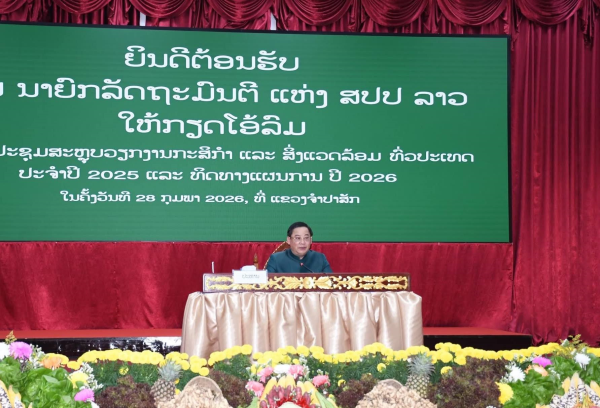
He stressed that agricultural production must follow a self-reliant and independent economic direction, prioritizing domestic capacity in plant and animal breeding, scientific techniques, and key production inputs. Greater attention should be given to soil improvement, preservation of productive agricultural land, and the development of concentrated production zones supported by appropriate infrastructure. The Prime Minister also called for expanded domestic production of animal feed, fertilizer, pesticides, and veterinary medicine to reduce reliance on imports.
Effective water resource management was highlighted as essential to maximizing agricultural output. During the rainy season, authorities were urged to promote extensive wet-season rice cultivation, while the dry season should focus on high-value cash crops. He also emphasized strengthening processing, sanitation standards, and the circulation of goods within and between provinces, alongside establishing seed banks and food reserves to enhance resilience against natural disasters and climate change.
The Prime Minister called for intensified promotion of commercial agricultural production to meet domestic demand, replace imports, and expand exports. Agricultural development should be closely linked with processing industries to create added value and generate new sources of national revenue. Farmers should be supported in adopting modern production methods and meeting higher quality standards to improve incomes and livelihoods. Production planning must be targeted, market-oriented, and aligned with the comparative advantages of each region, with stronger market access negotiations, particularly with strategic and neighboring countries.
He further encouraged policies to attract investment in clean, fresh, and organic agriculture, including on-site processing to increase value. Promoting domestic consumption of high-quality locally produced goods and expanding agricultural supply chains for the tourism sector were also identified as priorities.
Modernization of production structures was underscored through the promotion of new-style production groups, cooperatives, and farm-based enterprises applying scientific techniques and large-scale production models. Strengthening the cooperative sector and supporting small and medium enterprises in agriculture were seen as key steps toward industrialization, cost reduction, improved efficiency, and enhanced competitiveness.
On environmental management, the Prime Minister stressed strict forest protection and sustainable utilization in response to climate change, aiming to achieve the national forest cover target of 70 percent. Restoration of degraded forests and planned tree planting were identified as essential measures to mitigate droughts and floods and ensure stable water sources for agriculture.
Land management and development were also prioritized. Authorities were instructed to implement the National Land Master Plan nationwide, accelerate land title issuance, and resolve persistent challenges such as land encroachment, overlapping titles, illegal transfers, and slash-and-burn practices. Recognition of land use rights for communities residing in designated forest areas was highlighted as a key task.
In addition, he called for strengthened environmental protection through integrated natural resource management, spatial planning, waste management, and enhanced water governance. Relevant sectors were urged to improve coordination in integrated water resource management, balance water supply from hydropower and irrigation reservoirs, and strengthen monitoring, early warning systems, and pollution control. The establishment of a National Water Resources Committee and the development of groundwater reserves as a strategic drought response were also proposed.
Finally, rural development and poverty reduction were emphasized as central national priorities. The Prime Minister called for a comprehensive strategy linking rural development with resettlement policies, stable livelihoods, and job creation through increased private sector participation. These efforts should be implemented alongside grassroots governance initiatives under the “Three Builds” directive to ensure sustainable and inclusive development.
KPL

