KPL
Prime Minister Sonexay Siphandone has highlighted the achievements of the 9th Five-Year National Socio-Economic Development Plan (2021–2025), noting that its implementation took place amid a rapidly changing, complex, and unpredictable regional and international environment that presented both opportunities and challenges.
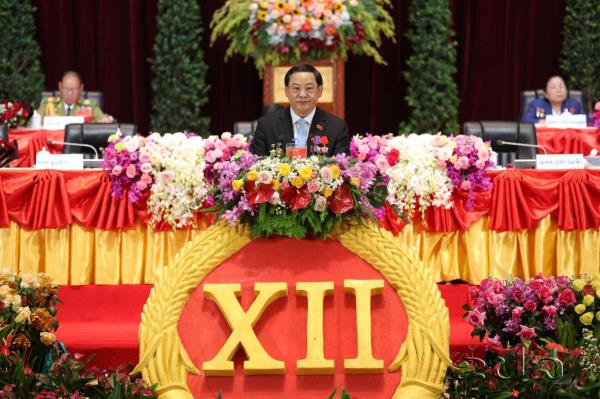
Prime Minister Sonexay Siphandone
The statement was made at the 12th National Congress of the Lao People’s Revolutionary Party in Vientiane on January 6.
He noted that domestically, the country faced significant economic and financial difficulties, prolonged impacts from the COVID-19 pandemic, as well as severe and recurring natural disasters. Despite these challenges, the Prime Minister emphasized that, through the collective efforts of all sectors, the implementation of programs and projects under the 9th Five-Year Plan delivered significant and noteworthy results.
Over the past five years, the Government focused on implementing a range of economic recovery measures, with particular emphasis on promoting production and services to sustain economic growth. Key measures included reopening the country following the COVID-19 pandemic; promoting domestic production for import substitution and exports, supported by credit provision for economic recovery; implementing pilot mineral projects; promoting tourism; and improving domestic and international transportation services, among other initiatives.
As a result of these efforts, average Gross Domestic Product (GDP) growth reached 4.24 percent, exceeding the plan’s target of 4 percent. GDP per capita reached USD 2,138, compared to the planned target of USD 2,880, while Gross National Income (GNI) per capita reached USD 1,985, against a planned target of USD 2,280.
Sectoral performance also showed positive trends. The agriculture sector grew at an average rate of 2.9 percent, contributing 19.4 percent to GDP, surpassing the planned growth rate of 2.5 percent and a 15.3 percent GDP share. The industry sector recorded average growth of 4.7 percent, contributing 32.5 percent of GDP, exceeding the planned targets of 4.1 percent growth and a 32.3 percent share. Meanwhile, the services sector grew at an average rate of 4.5 percent, contributing 36.6 percent of GDP, although remaining below the planned targets of 6 percent growth and a 41.3 percent GDP share.
The Prime Minister affirmed that these achievements reflect the resilience of the national economy and the effectiveness of coordinated efforts across sectors in advancing socio-economic development during a challenging period.
KPL

