KPL
On 23 November 2026: The World Food Programme (WFP) and the Department of Agricultural Extension and Cooperatives (DAEC), Ministry of Agriculture and Environment, held a handover ceremony for dry-season agricultural cash support under the project "Promoting Women's Agricultural Production for Climate Change Adaptation." The support reached 1,001 women from 23 target villages: 11 in Xon District and 12 in Xamtai District. The ceremony took place in Xon Tai Village, Xon District, Houaphan Province.
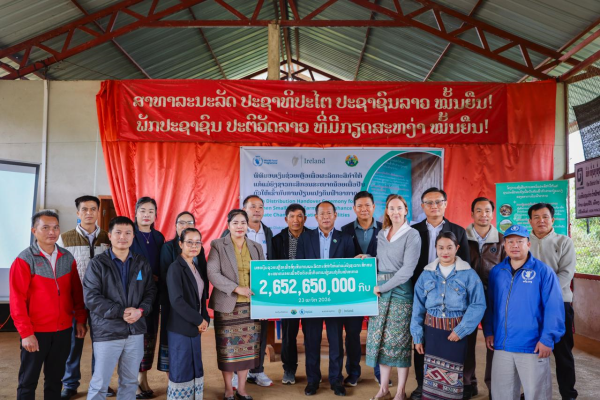
(KPL) On behalf of WFP, the support was presented by Ms. Malika Gudelian, WFP Head of Programme. Ms. Sulilak Khamvongsa, Deputy Head of the Provincial Department of Agriculture, Houaphan Province, received the support on behalf of the beneficiaries.
The three-year project is implemented in Xon and Xamtai districts with funding from the Government of Ireland. It aims to strengthen the food security and nutrition of vulnerable women and to build their resilience to climate change. It focuses on disaster-prone target villages and combines support for agricultural adaptation, small-scale financial assistance for agricultural production, and community-based disaster risk management.
This is the second round of support to women farmers in the project's target villages. The cash enables them to purchase dry-season production inputs, including crop seeds, livestock, fertilizer, materials and other essential equipment.
In the first round, delivered in May this year, 998 women farmers received support to purchase inputs for the rainy season.
In this round, each of the 1,001 women farmers from the 23 villages in Xon and Xamtai districts will receive LAK 2,650,000 per household, for a total of LAK 2,652,650,000. The funds will be invested in agricultural production to strengthen food security and increase household incomes.
Alongside the cash support, WFP and DAEC have provided training for women on household financial management, nutrition promotion, coping with climate change, and climate-smart agricultural techniques. These activities are part of broader efforts to strengthen the capacities of women farmers so that they can apply climate-resilient production practices and reduce the impacts of natural hazards, ultimately improving the quality of life, food security and well-being of women and households in rural areas.
KPL

