KPL
The Ministry of Agriculture and Environment, in partnership with WWF-Laos, has launched a six-year project to strengthen climate resilience, improve water security and support sustainable livelihoods across Sayaboury Province.
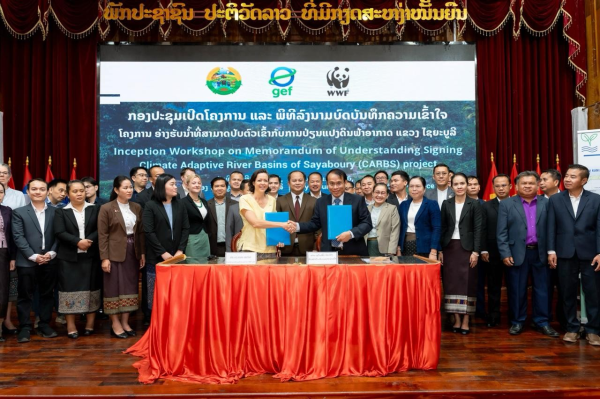
The Climate Adaptive River Basins of Sayaboury Province (CARBS) project, running from 2026 to 2031, is funded by the Global Environment Facility (GEF) with a total budget of US$6.77 million. It will promote integrated water resource management, nature-based solutions and community-led climate adaptation across four river basins.
The project was formally launched with the signing of a Memorandum of Understanding in Sayaboury Province on August 11 by Mr. Oudomsack Philavong, Director General of the Department of Water Resources (DWR) under the Ministry of Agriculture and Environment, and Ms. Heron Holloway, Country Director of WWF-Laos.
The agreement establishes cooperation between the government and WWF-Laos, in collaboration with provincial and district authorities, local communities and development partners, to implement the project over the next six years.
“Climate change is one of the greatest challenges facing water resources in the Lao PDR. Water security is fundamental to the well-being of our people, our economy and our environment,” said Oudomsack Philavong.
He said the project reflects the government’s commitment to integrated water resource management and sustainable development, while expressing confidence that it will deliver lasting benefits for people in Sayaboury and contribute to the country’s long-term climate resilience.
The project will cover 18 villages in six districts — Hongsa, Xaysathan, Sayaboury, Phiang, Paklay and Thongmixay — across the Nam Houng, Nam Poui, Nam Poun and Nam Lay river basins. More than 19,000 people are expected to benefit, around half of them women.
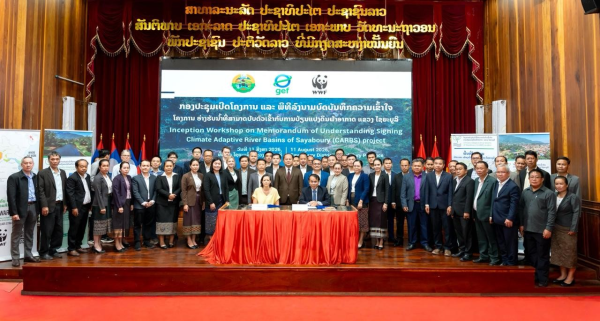
The project comes as communities face increasing climate-related challenges, including more frequent floods, prolonged droughts and unpredictable rainfall. It aims to improve water security and strengthen communities’ ability to adapt while protecting the river basins, forests, wetlands and freshwater ecosystems that support agriculture, livelihoods and biodiversity.
The project area also includes Nam Poui National Protected Area and the Nam Houng Protection Forest, two important conservation landscapes in Lao PDR. Nam Poui, an ASEAN Heritage Park, supports one of the country’s largest remaining wild Asian elephant populations and has been identified as the highest-priority landscape for tiger recovery under the National Tiger Recovery Action Plan.
“This project brings together government leadership, science and the knowledge of local communities to help people adapt now, while protecting the rivers and forests they’ll depend on for generations,” said Heron Holloway, Country Director of WWF-Laos.
The CARBS project will focus on four main priorities: integrating climate change adaptation into provincial water resource management and river basin planning; improving water security through nature-based solutions, community-led water management and appropriate small-scale infrastructure; promoting climate-resilient livelihoods through climate-smart agriculture, livelihood diversification and community-based natural resource management; and building knowledge and capacity by documenting and sharing lessons and good practices.
Together, these efforts are expected to strengthen climate adaptation planning and integrated water resource management across six districts and four river basins in Sayaboury Province.
The project will also generate lessons and good practices that can support future climate adaptation and water resource management efforts across Lao PDR.
“Building resilience to climate change requires long-term investment, strong partnerships and locally led action,” said Jacquelyn Beattie, GEF Agency Coordinator at WWF-US. She said the experience and knowledge generated in Sayaboury will contribute to advancing GEF project objectives globally.
Community participation will be central to implementation. Target villages were selected through consultations involving communities, district and provincial authorities and technical agencies, with the aim of ensuring that project activities reflect local priorities, climate risks and development needs.
Phayvieng Vongkhamheng, National Project Coordinator at WWF-Laos, said the project would work closely with government agencies, local authorities and communities to understand the challenges facing each river basin and put practical solutions into action.
The launch marks a new phase of cooperation between the Ministry of Agriculture and Environment, WWF-Laos, GEF and communities in Sayaboury, with the partners aiming to strengthen climate resilience, improve water security and protect the natural resources on which local communities and wildlife depend.
KPL

