KPL
(KPL) The Lao PDR has so far avoided a major health crisis but has not been immune from the global economic downturn as the COVID-19-induced economic recession has affected the country through multiple channels including tourism, trade, investment, commodity prices, exchange rates, and lower remittances.
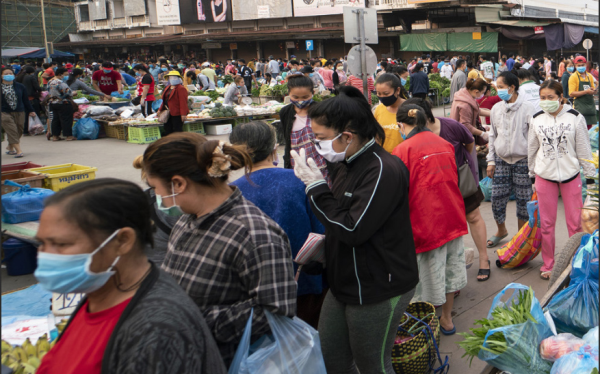
Khuadin Market, Vientiane Capital/Photo by Phoonsap Tevongsa
(KPL) The Lao PDR has so far avoided a major health crisis but has not been immune from the global economic downturn as the COVID-19-induced economic recession has affected the country through multiple channels including tourism, trade, investment, commodity prices, exchange rates, and lower remittances.
Given the uncertainty regarding the duration, pervasiveness, and severity of the COVID-19 outbreak at both the global and domestic levels, this report presents a range of growth estimates for 2020 under two scenarios.
These scenarios reflect different assumptions regarding the duration and depth of outbreaks and lockdown in the Lao PDR, the magnitude and effectiveness of economic relief policies, and the depth and duration of the global downturn.
In the more favorable scenario, the Lao PDR’s economy is expected to grow at 1 per cent, while in the downside scenario, the economy could contract by 1.8 per cent in 2020. In either case, this will be the slowest growth rate since 1990.
The COVID-19 shock has further aggravated the long-standing structural vulnerabilities in the economy. The country has a legacy of weak macroeconomic management, resulting in limited fiscal and foreign currency buffers even before the global pandemic. The level of international reserves is at a multiyear low.
The gap between the official and parallel market exchange rates has increased and is higher than historical norms. Despite lower public expenditure, weak revenue collection has resulted in an elevated fiscal deficit.
The fiscal deficit is expected to rise to 7.5 to 8.8 per cent of GDP and public debt to 65 to 68 per cent of GDP in 2020, leaving the country at high risk of debt distress.
Limited fiscal space and the mounting pressure of deficit financing and debt servicing will limit the ability of the government of the Lao PDR (GoL) to stimulate the economy, exacerbating the downturn.
The COVID-19 crisis has affected mostly labor-intensive sectors and those linked to global and regional value chains. Tourism-related sectors, including transport, food, and accommodation services and the retail trade have been hard hit due to fewer tourists from China and other neighboring countries in the first quarter of 2020.
This situation is likely to have further deteriorated in the second quarter due to travel restrictions adopted in other countries, the continued closure of Lao borders, and the current domestic lockdown.
Investment in these sectors is also expected to moderate. Small and medium-sized enterprises (SMEs) are particularly vulnerable in the current crisis. Supply chain disruptions have caused delays in delivering inputs to manufacturing industries and the construction sector. Export-oriented industries have also been significantly hit by lower external demand.
The containment measures in the Lao PDR and by key economic partners are causing unprecedented disruption to the labor market.
A sharp drop in demand is leading to job losses in tourism-related sectors, which account for 11 per cent of total employment. As the labor market comprises a considerable share of informal employment and workers outside the social insurance system, protection is minimal. To help those affected, the GoL is providing social insurance support to around 96,000 affected workers who are members of social insurance scheme.
However, this coverage amounts to only 3.1 per cent of total employment and 26 per cent of total urban wage workers.
Economic shock due to COVID-19 is also adversely impacting the flow of remittances and could push as many as 214,000 people into poverty.
Since the outbreak began, more than 100,000 migrant workers have returned to the Lao PDR. This has resulted in an estimated reduction of up to US$125 million in remittances in 2020, or 0.7 per cent of GDP. Around 9 per cent of households receive remittances from abroad, and remittances constitute 60 per cent of their household income.
This implies a significant reduction in recipient household income. Based on the two growth scenarios, poverty is estimated to increase by 1.4 to 3.1 per centage points in 2020. In other words, poverty is estimated to increase by about 96,000 people as a result of the pandemic, or by 214,000 people if the downside scenario prevails.
The impact of the pandemic on poverty is expected to linger, with poverty projected to return to its pre-crisis level in 2021 under the upside scenario, or later than 2022 under the downside scenario. Public finances will reach a new low.
Weak performance in the real sector will exacerbate the country’s already weak fiscal position, further eroding fiscal space. Declining business income, particularly in the services and manufacturing sectors, resulted in lower GoL revenue collection in the first two months. Preliminary estimates indicate that domestic revenue collection for January–February 2020 dropped by 30 per cent year-on-year.
The Ministry of Finance (MoF) estimates that revenue loss for 2020 will be about 3 to 4 per cent of GDP, mostly from the fall of value-added tax (VAT), excise tax, profit tax, and customs duties.
As a result, the fiscal deficit is estimated to increase to 7.5 to 8.8 per cent of GDP in 2020 from 5.2 per cent in 2019, while public debt is estimated to rise to around 65 to 68 per cent of GDP from 59 per cent during the same period. The risk of debt distress remains high.
KPL

