KPL
It is late on a Friday evening on the outskirts of Vientiane. The two-lane road is crowded with people heading home for the weekend, but on the third floor of the Lao Statistics Bureau (LSB), a team is still at work.
Inside a quiet, air-conditioned office, Mr. Lienthong Souphany, Head of the Central Census Office, and two staff members are gathered around a laptop. Their eyes are fixed on a digital dashboard. As one team member scrolls from the northern peaks of Phongsaly down to the southern reaches of Attapeu, another records the real-time data flashing on the screen.
“We are tracking the progress of nationwide data collection in real time,” explains Mr Lienthong. “This system allows us to see exactly how the work is progressing so that we can keep everything on track.”
This “real-time monitoring system” is one of the key features of the 2025 Population and Housing Census (PHC), the first-ever digital census in the Lao PDR. This development marks a major shift from a paper-based approach to a modernised census, transforming the way population and demographic data are collected, stored, and used in the country.
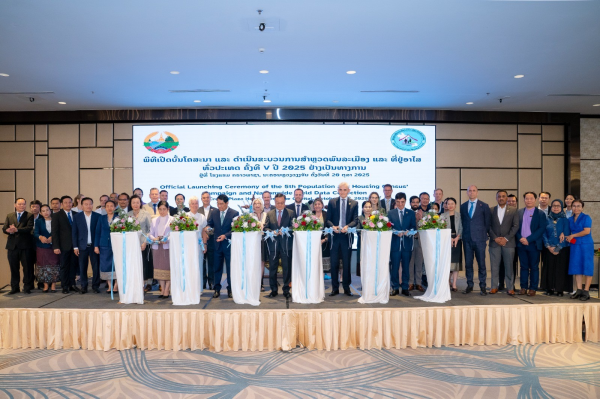
After four years of preparation under the strong leadership of the Government of the Lao PDR, and with technical support from UNFPA and development partners including Australia, China, Switzerland, Luxembourg, the United States, Germany, the World Bank and other UN agencies, nationwide field data collection for the 2025 PHC was launched on 3 November 2025.
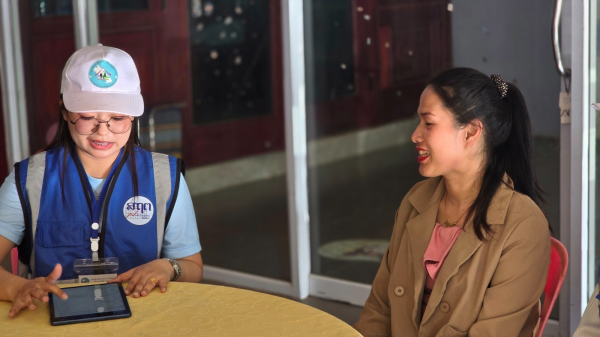
During this eight-week period, more than 12,000 trained enumerators were deployed across the country. In a major advance on previous censuses, they replaced paper forms with tablets equipped with smart interviewing software. This enabled data to be synchronised instantly to a secure central server at the LSB, giving the management team a “live” view of census progress.
In previous censuses, reliance on paper forms created a significant delay between data collection and analysis. Millions of physical documents had to be transported from across the country, including remote areas, to a central location where they were manually coded and entered into databases—a process prone to human error and physical damage. By contrast, the 2025 digital approach uses tablets with built-in validation checks, ensuring that information is verified at the point of entry and preventing inconsistent or missing data before enumerators even leave the household.

Under the paper-based system, supervisors often had to wait weeks to identify bottlenecks or errors in the field. With the new real-time monitoring system, the Lao Statistics Bureau can track the progress of more than 12,000 enumerators through GPS-tagged submissions and instant synchronisation. This “live” visibility enables immediate troubleshooting and quality control, ensuring that the census is not only faster but also significantly more accurate than any previous effort.
By 28 December, field data collection had covered 3.6 million buildings, achieving 99 per cent of the target. To ensure that no one was left behind, a follow-up mission revisited more than 3,500 areas in early 2026 to reach those who may have been missed.
Mr Vilaysook Sisoulath, Deputy Head of the Socio-Economic Statistics Department at the LSB, describes the 2025 census as the most advanced statistical operation in the country’s history.
“Unlike the old paper-based methods, we now use satellite imagery and digital maps to identify every household,” he says. “This technology makes it much easier for our teams to locate homes and reach their targets. It also makes the work trackable; if we see progress slowing in a specific area, we can immediately advise local committees to provide additional support.”

Mrs. Phetsamone Sone, Head of the LSB, notes that the 2025 census is about more than just numbers; it provides the baseline for the country’s next five-year development plan (2026–2030).
“I remember our last census ten years ago,” she recalls. “We had to print millions of paper questionnaires and transport them to every remote village. It took weeks just to receive a progress update. Today, that delay has been eliminated. Digitalisation has made our data collection faster, more accurate and far more efficient.”
Mrs. Phetsamone, who is also a member of the National Assembly, emphasises that this achievement was built on strong partnerships. She credits the leadership of the Lao Government alongside the technical and financial support provided by UNFPA and development partners.
UNFPA Representative Dr Bakhtiyor Kadyrov notes that the success of the 2025 census was made possible through close collaboration between the Government, UNFPA, development partners and other stakeholders.
“A census is not just about numbers; it is about people. The data generated will inform policies designed to improve people’s well-being, ensure that everyone benefits from development, and ensure that no one is left behind,” he says.
After four years of preparation, the 2025 Census has now moved from data collection to the analysis and reporting phase. The knowledge and technology gained through this first digital census have transformed the statistical landscape of the Lao PDR. They have also laid a strong foundation for further modernisation, enabling the country to produce high-quality data that will help shape a more inclusive and prosperous future where no one is left behind.
KPL

