KPL
President Thongloun Sisoulith has called for major improvements in the management and governance of state-owned enterprises, warning that weak structures and poor planning continue to undermine profitability.
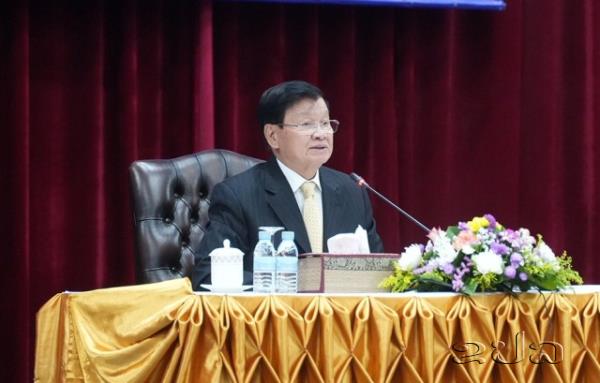
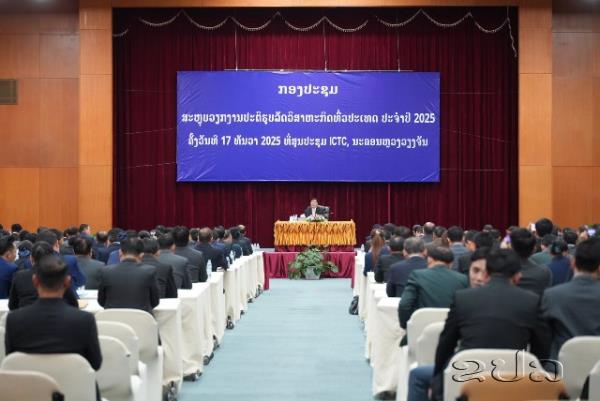
He made the remarks on December 17 while attending a meeting to review the 2025 performance of the State Enterprise Reform Committee and to discuss priorities for 2026.
The President said relevant sectors must improve management mechanisms, particularly in large state enterprises. He stressed that boards of directors should be strengthened, with board chairpersons at deputy minister level serving full-time as Party secretaries within enterprises.
He said board members and executive committees must be appointed based on professional knowledge, capability and expertise. He also called for a clearer division of responsibilities between the central-level State Enterprise Reform Committee, the Ministry of Finance, and supervising ministries, organisations and local authorities.
Mr Thongloun said business plans must be improved to ensure effectiveness and profitability, and to prevent the erosion of state capital.
Clarifying roles and fixing debt
The President also urged the State Enterprise Reform Committee to clearly define the roles of state-owned enterprises. He said the relationship between the state’s macroeconomic management role and enterprises’ ownership rights and operational autonomy must be properly separated.
He said state enterprises should be strong enough to implement Party and state policies, respond to urgent economic challenges and handle strategic tasks that the private sector is unable to undertake.
Within the next five years, he said debt problems in state enterprises must be resolved, alongside improvements in transparency and good governance. He also emphasised the need to strengthen integrity and accountability among enterprise managers and staff.
Following the conclusion of the 12th Party Congress, he said reform strategies and development plans for state enterprises should be submitted to the government and the Party Central Committee’s Political Bureau for guidance.
He described the process as a necessary step towards a “revolution” in state-owned enterprise reform to make them stronger, more stable and more effective.
Reform plans for 2026
The meeting was chaired by Mr Saleumxay Kommasith, Deputy Prime Minister and head of the State Enterprise Reform Committee. Participants included committee members, representatives from ministries, provinces and state enterprises nationwide, as well as representatives of the World Bank in Laos.
Mr Kikeo Chanthaboury, Deputy Head of the Party Central Office and Deputy Head of the Reform Committee, presented a report on the progress of state enterprise reform in 2025 and outlined plans for 2026.
He said reforms would follow a resolution of the Party Central Committee’s Political Bureau, which calls for strengthening state-owned enterprises and, where appropriate, transforming them into joint-stock or mixed-ownership companies.
Under the resolution, state-owned enterprises are expected to play a central role in promoting economic growth, capital accumulation and public service delivery, while also supporting national defence and security.
The resolution sets out six priority tasks, including improving management mechanisms, clearly separating political and security objectives from economic goals, refining policies and regulations, studying mixed-ownership models, strengthening state oversight, and improving the leadership and activities of Party and mass organisations within state-owned enterprises.
KPL

