KPL
Flooding across Khammouane Province between July and August 2026 has affected around 151,000 residents across all 10 districts, with preliminary damage estimated at more than 275.57 billion kip, as provincial authorities accelerate recovery efforts and further damage assessments.
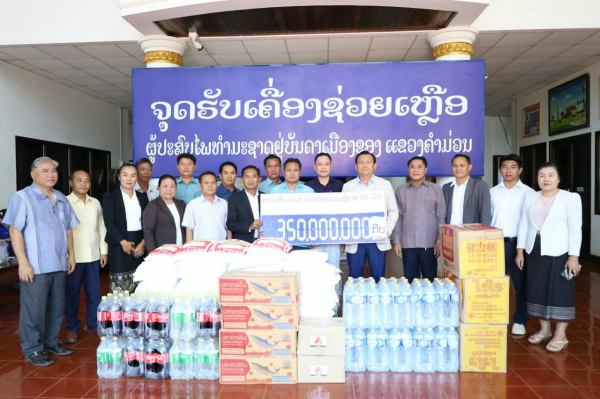
(KPL) Flooding across Khammouane Province between July and August 2026 has affected around 151,000 residents across all 10 districts, with preliminary damage estimated at more than 275.57 billion kip, as provincial authorities accelerate recovery efforts and further damage assessments.
An emergency response and flood mitigation readiness meeting was held on September 3, 2026, at the Provincial Office, chaired by Mr. Detsakda Manykham, Vice President of the Khammouane Provincial Administrative Committee and Chairman of the Provincial Disaster Management Committee, with disaster management committee members from provincial and district levels in attendance.
Mr. Sengphet Khamsoukthavong, Deputy Head of the Khammouane Provincial Department of Labour and Social Welfare, reported that the province experienced two major waves of flooding.
The first wave, from July 3–17, affected 121 villages, 6,291 households and 31,381 residents, with preliminary damage estimated at 136.99 billion kip.
The second wave, from August 5–31, submerged 33,637 hectares of farmland, killed 9,856 livestock and left another 731 animals missing. It also caused extensive damage to provincial, district and rural roads, bridges, irrigation systems, schools and health facilities.
Due to the severity of the flooding, 7,346 residents from 1,489 households in 17 villages were evacuated from high-risk areas. All displaced residents have since returned to their homes.
The province allocated 1.37 billion kip in relief assistance across the 10 districts and mobilized 3.83 billion kip in financial donations, along with emergency response equipment valued at more than 4.35 billion kip. Six emergency shelters and more than 10 rescue boats were also deployed to affected areas.
Mr. Detsakda emphasized that the immediate priority following the recession of floodwaters is post-disaster recovery, particularly the prompt repair of roads, bridges, irrigation systems, schools and clean-water facilities.
He also instructed relevant agencies to continue collecting and verifying comprehensive damage data, particularly in the agriculture, transport and education sectors, to facilitate requests for recovery assistance and strengthen the province’s preparedness for future disasters.
KPL

