KPL
International Digital Economy Governance and Leadership Capacity-Building Programme (Session 2) Wraps Up
On July 5, the International Digital Economy Governance and Leadership Capacity-Building Programme (Session 2) concluded at the National Information Technology Innovation Park Conference Center.
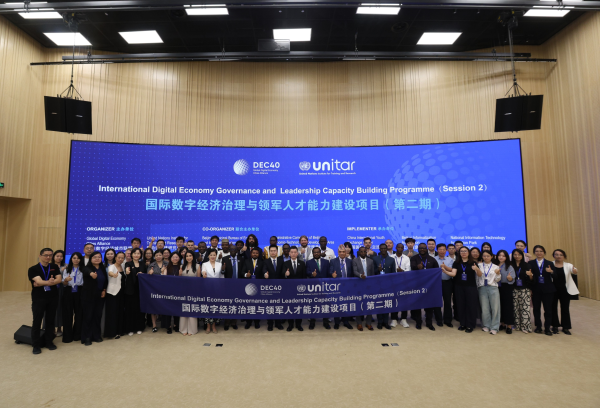
The Programme was jointly launched by the Global Digital Economy Cities Alliance (DEC40) and the United Nations Institute for Training and Research (UNITAR), in collaboration with the Beijing Municipal Bureau of Economy and Information Technology and the Administrative Committee of Beijing Economic-Technological Development Area. China International Youth Exchange Center, Beijing Informatization Association, and the National Information Technology Innovation Park served as co-organizers.
The Programme brought together more than 20 government officials, policymakers, and digital industry leaders from 13 countries across Asia, Africa, Europe, and Latin America.
You Jing, Secretary-General of DEC40 and Director of the International Exchange and Cooperation Division of the Beijing Municipal Bureau of Economy and Information Technology, delivered a review and summary of the Programme. She also outlined the next phase of the initiative, which will align participants' needs with Beijing's resources while strengthening long-term engagement and support.
Five participant representatives delivered remarks, sharing their experiences and benefits from the Programme: Mr. Upendra Kark, Mayor of Kageshwori-Manohara Municipality, Bagmati Province, Nepal; Mr. Pavel Fondukov, Counsellor at the Permanent Mission of the Russian Federation to the United Nations; Mr. Ismail Haleem, Member of the Malé City Council, Republic of Maldives; Mr. Erick Daniel Mang'era, Senior Economist in the Financial Development Division of Tanzania's Ministry of Finance; and Ms. Nicole Chow Ning Ngeow, Executive Director of Prudence Foundation, Malaysia. The closing ceremony concluded with the presentation of completion certificates to all participants.
At the closing ceremony, Liu Weiliang, Member of the Leading Party Members' Group and Deputy Director of the Beijing Municipal Bureau of Economy and Information Technology, delivered the closing address. He said Beijing will continue to leverage its strengths in the digital economy and international exchange to further enhance its international digital leadership development system, build a stronger talent cultivation network, and steadily improve a full-cycle service mechanism encompassing "training, exchange, networking, and implementation." He emphasized Beijing's commitment to working with cities, institutions, and enterprises around the world to promote digital development concepts, advance practical cooperation, and contribute to global digital governance.
Session 2 of the Programme represents a key initiative responding to the need for reforms in the global digital governance system while supporting the development of "Digital China" and the Global Development Initiative. Guided by the global governance principle of extensive consultation, joint contribution, and shared benefits, it aims to build an integrated international cooperation platform that combines "training + forums + enterprises + projects." Leveraging the DEC40 and UNITAR platforms, the Programme incorporated the Global Digital Economy Conference into its core curriculum and highlighted Beijing's digital economy achievements to establish a collaborative framework linking industry, application scenarios, and innovation ecosystems.
The Programme also delivered multiple tangible cooperation outcomes. Twelve government departments, institutions, and enterprises applied to join DEC40; the Alliance signed a memorandum of cooperation with IMPACT FOR AFRICA from Chad; and participants from various countries expressed interest in partnering with Beijing-based enterprises in areas including technology adoption, project implementation, and talent development, with a particular focus on digital government, intelligent industry, and digital workforce development.
To date, two sessions of the Programme have been held, accelerating the development of a cross-regional, cross-institutional, and cross-cultural digital governance cooperation network spanning 46 cities in 30 countries.
KPL

