KPL
The government has identified 10 priority tasks to stabilize the economy and promote sustainable growth, as part of efforts to build an independent and self-reliant economy.
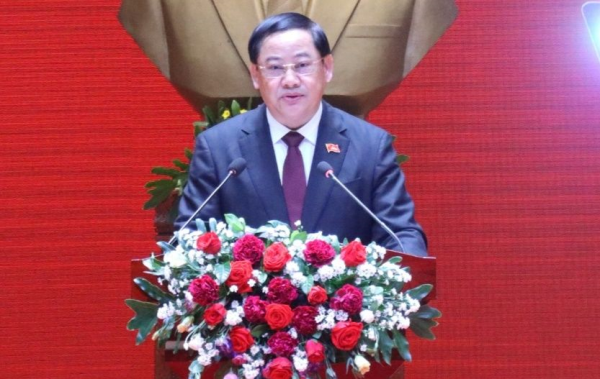
(KPL) The government has identified 10 priority tasks to stabilize the economy and promote sustainable growth, as part of efforts to build an independent and self-reliant economy.
Prime Minister Sonexay Siphandone outlined the priorities while disseminating the 10th Five-Year National Socio-Economic Development Plan, emphasizing the need to expand and diversify production and services, address economic and financial challenges, and accelerate quality economic growth.
The first priority focuses on boosting agricultural production to ensure food security, promote domestic self-sufficiency and increase exports. The government will also encourage agro-processing industries such as rubber, cassava, sugarcane and fish processing, as well as fertilizer, animal feed and seed production to add value to agricultural products and create rural employment.
Second, the government will promote clean and alternative energy development, including hydropower, solar, wind and biomass, while expanding the national power grid and strengthening regional electricity connectivity to support cross-border energy trade.
Third, authorities will accelerate mineral processing by reducing the export of raw materials and encouraging value-added production such as gold refining, steel and copper smelting, aluminum production, potash processing and rare earth processing.
Fourth, the government will promote investment in full-cycle processing industries, including electrical appliance parts, electronics and vehicle components, particularly within special economic zones and industrial parks. Import substitution for consumer goods will also be encouraged.
Fifth, tourism development will focus on areas with strong potential, including nature-based, cultural, historical, agricultural and sports tourism, with improvements to infrastructure, safety standards and service quality to ensure sustainable tourism growth.
Sixth, logistics and transport systems will be improved to transform Laos into a regional transit and distribution hub. The government plans to modernize key dry ports including Thanaleng Dry Port, Savannakhet Dry Port, Khammouane Dry Port and Champasak Dry Port, while expanding other logistics zones and trade facilitation infrastructure.
Seventh, the government will accelerate digital development by expanding telecommunications infrastructure, high-speed internet, national data centres, e-government systems, digital land management and e-commerce platforms.
Eighth, macroeconomic management will be strengthened to maintain economic stability through improved revenue collection, stricter fiscal discipline and more effective public debt management.
Ninth, monetary and exchange rate policies will continue to follow market mechanisms with effective state management, while efforts will be made to control inflation and strengthen foreign currency reserves.
Tenth, the government will enhance the efficiency of state investment, improve the business environment for private investment and reform state-owned enterprises to improve their financial performance and contribution to the national budget. Key state enterprises include Electricité du Laos and Lao Airlines, alongside other strategic companies.
The Prime Minister emphasized that these priority tasks will play a crucial role in strengthening economic resilience and supporting sustainable development in the coming years.
KPL

