KPL
A senior Chinese scholar has identified institutional self-reform and anti-corruption as central pillars of China's approach to long-term governance, arguing that continuous self-correction is essential to maintaining public trust and political stability.
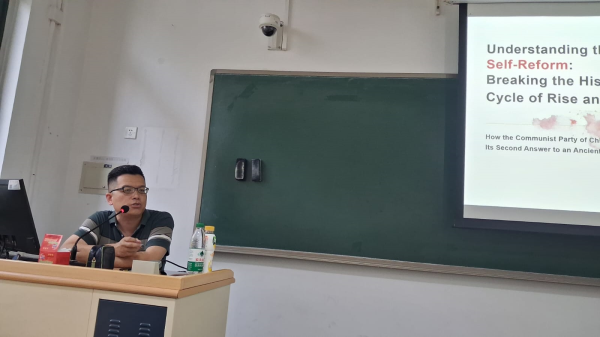
Speaking to an international delegation in Beijing on July 27, Professor Xia Lu of Renmin University of China said all political systems—regardless of their structure—face the challenge of sustaining legitimacy and avoiding institutional decline.
Drawing on China's historical experience, Xia said the Communist Party of China (CPC) has adopted self-revolution as a long-term governance strategy, emphasizing continuous reform, strict party discipline, and accountability rather than periodic corrective campaigns.
He said the approach has evolved into a comprehensive institutional framework aimed at preventing corruption and strengthening public confidence. A key principle, he noted, is that public power must operate within clearly defined legal and institutional constraints.
Xia highlighted several mechanisms supporting the system, including the Central Commission for Discipline and Inspection (CCDI), which oversees party discipline through an independent reporting structure, and the Eight-Point Frugality Code, introduced to curb bureaucratic excess, improve efficiency, and promote clean governance.
He also pointed to ongoing revisions of supervision laws, anti-corruption regulations, and integrity standards as evidence of efforts to institutionalize accountability rather than rely on temporary enforcement campaigns.
Concluding his lecture, Xia said the strength of any governing system lies not in claiming perfection, but in its ability to identify weaknesses, reform itself, and maintain public confidence through continuous institutional improvement.
KPL

