KPL
The global political and economic architecture is undergoing profound transformation, compelling states to reassess foreign policy strategies and seek partners beyond traditional alliances. In this shifting environment, relations between the Lao People’s Democratic Republic and the Republic of Azerbaijan present an instructive case of cooperation shaped not by geopolitical rivalry, but by pragmatism, complementarity, and shared diplomatic principles.
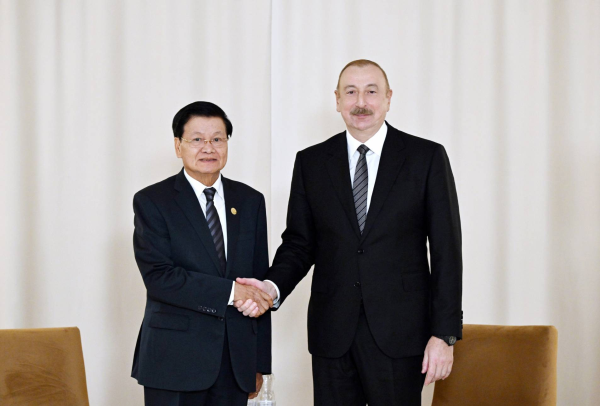
Thirty years after the dissolution of the Soviet Union, the external relations of its former republics and partners have been fundamentally reshaped by sovereignty, global integration, and regional realignments. For Laos and Azerbaijan, a relationship rooted in the Soviet era has gradually evolved into a modern, interest-based partnership adapted to the complexities of the 21st century.
Formal diplomatic relations between Laos and Azerbaijan were established in 1995, providing continuity from their earlier interaction within the Soviet sphere. In the immediate post-USSR decades, however, both countries understandably prioritised domestic consolidation and engagement with neighbouring regions and major powers. For Laos—a landlocked member of ASEAN—foreign policy centred on regional integration and close cooperation with partners such as China and Vietnam. Azerbaijan, endowed with significant hydrocarbon resources and strategically located at the crossroads of Europe and Asia, focused on consolidating independence, developing its energy sector, and positioning itself as a regional transport and energy hub. As a result, Lao–Azerbaijani relations during this period remained friendly but low-key, largely confined to mutual support in multilateral forums such as the United Nations, with limited high-level exchanges or economic interaction. The partnership, in effect, remained dormant and awaiting activation.
Over the past decade, both sides have made a conscious effort to revitalise bilateral ties, driven by shared interests in diversifying foreign relations and identifying niche areas of cooperation. Political and diplomatic engagement has increased, with more frequent ministerial and parliamentary-level exchanges. These interactions have often taken place within the framework of the Non-Aligned Movement, where both countries are active members. Azerbaijan’s chairmanship of the Movement from 2019 to 2023 provided an important platform for engagement with Laos and enhanced Baku’s diplomatic visibility in Vientiane.
Economic cooperation has also attracted growing attention, even though trade volumes remain modest. Azerbaijan’s experience in energy infrastructure, information and communication technology, agriculture, and transit logistics offers potential complementarities with Laos’s development needs. Its role as a Eurasian transport hub aligns conceptually with Laos’s ambition to transform from a landlocked to a “land-linked” country within ASEAN. Conversely, Laos’s experience in sustainable tourism, hydropower development, and light manufacturing may hold interest for Azerbaijani partners seeking diversification opportunities.
People-to-people exchanges have gradually expanded alongside official contacts. Cultural events, exhibitions, and academic cooperation initiatives have helped promote mutual understanding. Educational cooperation, including scholarships offered by Azerbaijan to Lao students, represents a long-term investment in bilateral relations by nurturing a generation of professionals with direct exposure to both countries.
At the multilateral level, Laos and Azerbaijan continue to share similar positions on sovereignty, territorial integrity, and the central role of the UN Charter in international affairs. This normative alignment provides a stable foundation for diplomatic cooperation and reinforces mutual support on issues of core national interest.
Looking ahead, the trajectory of Lao–Azerbaijani relations will be shaped by broader global trends. As the international system moves towards greater multipolarity, both countries have demonstrated an ability to pursue multi-vector diplomacy and engage flexibly with partners across regions. Their bilateral relationship reflects this approach, offering an additional channel for diversification beyond traditional alignments.
Cooperation in connectivity and digital transformation represents another potential avenue. Azerbaijan’s focus on East–West and North–South transport corridors complements Laos’s regional logistics ambitions, while exchanges in digital government and ICT could provide low-cost, high-impact benefits. Sustainable development and climate resilience also offer promising ground for cooperation, with Azerbaijan investing in renewable energy and green technologies and Laos contributing experience in hydropower, forestry, and natural resource management.
Finally, post-conflict reconstruction and demining present a unique opportunity for technical cooperation. Azerbaijan’s large-scale reconstruction efforts following the restoration of its territorial integrity in 2020 intersect with Laos’s extensive experience in unexploded ordnance clearance, gained through decades of addressing the legacy of war. This shared experience could support meaningful exchanges in capacity building and technical assistance.
Three decades after the collapse of the Soviet Union, Laos and Azerbaijan have moved beyond legacy ties to shape a forward-looking, pragmatic partnership. The foundations laid over the past decade through enhanced dialogue and multilateral coordination now offer an opportunity to translate political goodwill into concrete, economically viable cooperation. In an era of global uncertainty and shifting geopolitical and economic patterns, the evolution of Lao–Azerbaijani relations illustrates the growing importance of flexible, issue-based partnerships as a source of resilience and sustainable development.
By: Mr. Vankham Phetphaivanh, Mr. Mamedzada Kamandar Zahid oglu, 1st year master's degree, RUDN - Peoples' Friendship University of Russia (Moscow, Russia) and Ms. Sakovich Anastasia Dmitrievna, 3th year, KFU - Kazan Federal University, (Kazan, Russia).
KPL

