KPL
In a major move to fortify the country's financial safety net and boost public confidence, Bank of the Lao PDR (BOL) Governor Bounkham Vorachit presented the draft Law on Deposit Protection to the second ordinary session of the 10th National Assembly on Monday, Oct. 19.
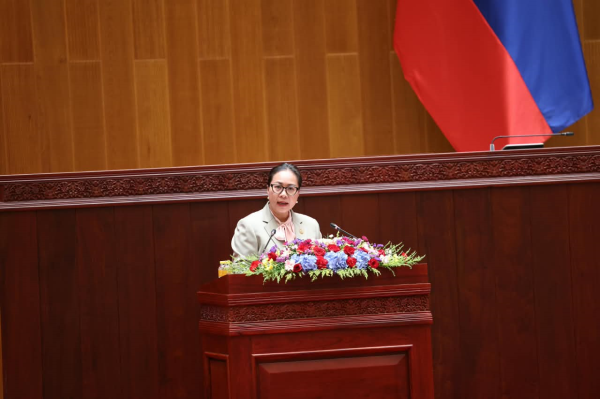
Presenting the draft legislation, the official emphasized that a robust legal framework is vital for safeguarding depositors and aligning the nation's financial mechanisms with international standards.
The deposit protection framework in Laos traces its roots to the 1997–1998 Asian financial crisis, when regional banking failures prompted the government to establish a financial safety net. Initially operating as a state-owned enterprise known as the Deposit Protections Fund in 1999, the institution gained financial self-sufficiency in 2007.
In October 2017, the fund's status was upgraded to a state financial organization equivalent to a government department, officially renaming it the Deposit Protection Office (DPO).
Currently, the DPO protects up to 100 million LAK per depositor at each member institution. This ceiling covers 94% of all protected depositors and exceeds twice the national GDP per capita. Membership has expanded from just seven commercial banks in 2000 to 41 institutions today—comprising 35 commercial banks and six deposit-taking microfinance institutions—all while maintaining a flat deposit insurance premium rate of 0.1% per annum since 1999.
Key Provisions of the New Law
While the 2017 decree laid a solid foundation, implementation over the past nine years exposed several critical limitations that necessitate comprehensive legislation. The proposed law addresses these through several key updates.
The legislation shifts away from the flat 0.1% premium, which fails to reflect actual risk profiles. The new law introduces a risk-based premium structure, capped at 1%, to incentivize better internal risk management among financial institutions.
The DPO will transition from a "paybox" model—which merely reimburses depositors during bank failures—to a "paybox plus" system. This grants the DPO legal backing to actively use the fund to resolve troubled institutions through liquidity support or mergers, aligning with International Association of Deposit Insurers (IADI) core principles.
Higher Coverage Limits
Acknowledging public feedback that the 100 million LAK cap is too low, the new law stipulates that the maximum coverage limit must be no less than three times the GDP per capita, ensuring protection for at least 90% of all insured depositors.
Drawing on international standards, the law introduces legal protections for DPO staff acting in good faith while executing their duties, shielding them from unjust lawsuits or harassment.
All deposit-taking microfinance institutions will be legally mandated to join the DPO. The law also clarifies roles, information-sharing, and crisis-management protocols among financial safety net participants, including the BOL and the Ministry of Finance.
Projected Outcomes
The newly drafted legislation comprises 66 articles across eight chapters. Once enacted, it is expected to play a pivotal role in achieving the targets of the 10th National Socio-Economic Development Plan (2026–2030), specifically aiming to push the total deposits-to-GDP ratio above 90%.
By raising deposit limits, expanding membership, and enhancing crisis-response tools, the governor say the legislation will significantly reduce the risk of bank runs and reinforce long-term stability across the Lao financial sector.
KPL

