KPL
In his opening remarks at the 3rd Review Conference of the Convention on Cluster Munitions (CCM) in Vientiane this morning, Prime Minister Sonexay Siphandone emphasized that healing the wounds of war requires shared humanitarian responsibility rather than individual state effort.
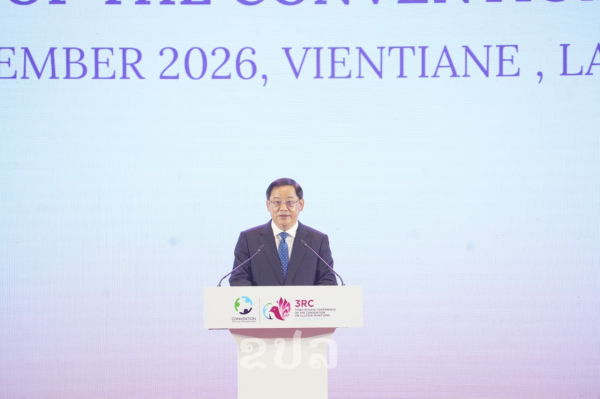
In his opening remarks at the 3rd Review Conference of the Convention on Cluster Munitions (CCM) in Vientiane this morning, Prime Minister Sonexay Siphandone emphasized that healing the wounds of war requires shared humanitarian responsibility rather than individual state effort.
Sixteen years after hosting the First Meeting of States Parties in November 2010—where the foundational Vientiane Declaration and Action Plan were born—the Lao PDR has welcomed back the international diplomatic community to evaluate treaty obligations and chart a collective course toward a world free from cluster munitions.
PM Sonexay called upon all States Parties, signatory states, observer states, and International partners to deepen cooperation. “Let us reaffirm our collective Resolve to advance the implementation of the CCM and uphold the relevance, purpose, and values of this vital humanitarian instrument amid today’s complex global landscape.”
More than five decades after the end of the Indochina War, unexploded ordnance (UXO) continues to threaten civilian lives and hinder national socio-economic development, making Laos one of the most heavily affected nations globally.
To fulfill its international treaty duties, the Lao Government has embedded its commitments into national frameworks, establishing national Sustainable Development Goal 18 (SDG 18): “Lives Safe from UXO” to tie clearance directly to poverty eradication.
The conference is expected to focus on adopting Vientiane Action Plan (2027-2031), a new actionable framework prioritizing accelerated survey and clearance, comprehensive victim assistance, and predictable international cooperation.
Scheduled for Sep 14-18, the conference unites a broad spectrum of stakeholders, including policymakers, clearance operators risking their lives in the field, international organizations, civil society advocates, and affected victims.
KPL

