KPL
Following the end of the That Luang Festival, the wax castle procession will continue to the Ongtue and Inpeang Temples due to the fact that King Xaysettharraj built all three, according to an address given by monk Pha Ajan Senghong Xayavong at Ongtue Temple on 14 November.
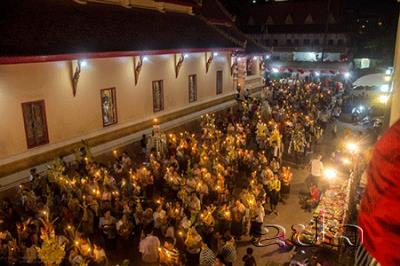
(KPL) Following the end of the That Luang Festival, the wax castle procession will continue to the Ongtue and Inpeang Temples due to the fact that King Xaysettharraj built all three, according to an address given by monk Pha Ajan Senghong Xayavong at Ongtue Temple on 14 November.
“Early in morning on 15 November, monks at Ongtue Temple prepared the area, decorating and cleaning around the temple to welcome laymen and laywomen bringing the wax castles”.
The monks prepared 108 small bowls in which to receive alms, for laymen /women to place coins in, and the box containing the papers that will tell people their fortunes (Siang zok, Siang Sy).
About 6 pm, local village authorities and local people of Chanthaboury district, nearby districts, and Vientiane Capital will join together with the wax castles at Ongtue Temple, and then continue to Inpeang Temple.
The ceremony will start around 7 or 8 and the worshippers will slowly walk around the Sim (sanctuary) three times in a clockwise direction, led by the monks and chanting the ancient words of Buddha. Individuals or groups carry the wax castles with lit candles on top to pray for good luck.
After that, the wax castle procession continues to the Inpeang Temple. Monks, laymen and laywomen walk slowly around the Sim three times in a clockwise direction and then give their wax castles to the monks at Inpeang temple.
Pha Ajan Senghong Xayavong said that worshippers are allowed to leave their wax castles with the monks at Ongtue Temple, but they should walk around the Sim three more times before giving their wax castles to the monks. They will then listen to prayers to the Buddha and then pour water on the ground to ask Ngamae Thorani (the female earth goddess) to tell the spirits of their relatives to come and receive their offerings.
It is assumed that the religious ceremonies of both temples are related due to the statues of both queens (queen of Xaisetthathiraj King and Myanmar King) and the Ongtue Buddha image. As a result, our ancestors have carried on this tradition for generations. This is according to the late President of the Lao Buddhist Fellowship Organisation Dr Phamaha Phong Samaleuk.
Ongtue Mahavihara was built in 1566 and is one of the ancient temples in Vientiane. It used to be regarded as an important temple in terms of a historical site, a sacred place where people constantly come to worship and it was also used as a place for official sacred ceremonies to verify the loyalty of government employees.
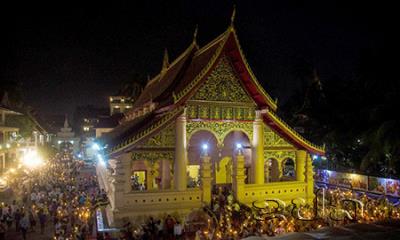
The Ongtue Temple is located on Sayasetthathiraj road near the centre of Vientiane capital; it is convenient for Buddhists to come, visit, and worship at the image.
In the past, the compound of Ongtue Mahavihara included Vat Inpeng, Vat Mixay, and Vat Haysok. Due to the socio-economic development of the country, it is now divided into four temples, physically separated by roads as we see today.
Vat Inpeang is one of the least visited temples in the center of Vientiane. It is located near the bank of the Mekong River.
Built in the 16th century, the temple was destroyed in 1827 during the invasion by the Siamese who destroyed most of the town. It has been rebuilt and renovated several times.
Vat Inpeng is an active temple with resident monks. On the grounds are a Sim with a porch that contains beautiful murals, a library building, a small chapel, and several other Buddhist structures. Access to the grounds is through a large, very elaborate entrance gate with green seven headed Naga snakes guarding the temple.
One of the oldest structures of Vat Inpeng is a small, square stone Ho Trai or library building adorned with stone sculptures on its entrance and windows. The Ho Trai is used to store the Tripitaka, the ancient manuscripts written on dried palm leaf containing the teachings of the Buddha.
KPL

