KPL
The Organization Board of the Lao People’s Revolutionary Party (LPRP) Central Committee, in cooperation with a delegation of experts from the Socialist Republic of Vietnam, held a seminar in Vientiane on September 8, 2026, to exchange experiences on working methods, leadership styles and coordination between Party and administrative authorities at various levels.
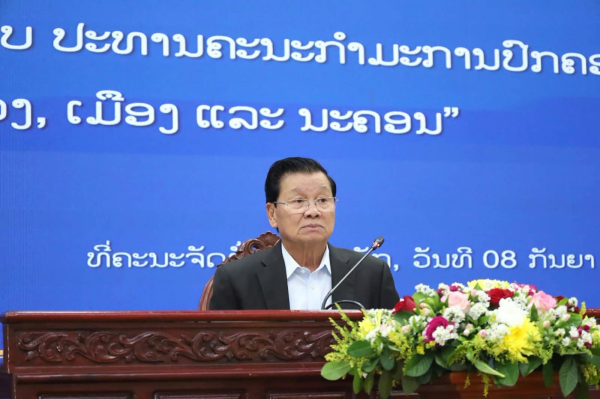
(KPL) The Organization Board of the Lao People’s Revolutionary Party (LPRP) Central Committee, in cooperation with a delegation of experts from the Socialist Republic of Vietnam, held a seminar in Vientiane on September 8, 2026, to exchange experiences on working methods, leadership styles and coordination between Party and administrative authorities at various levels.
The seminar, held under the theme “Working Methods, Style, and Coordination Relations between Party Committee Secretaries and Chairpersons of Administration Committees at the Capital, Provincial, District and Municipal Levels,” was chaired by General Vilay Lakhamphong, Political Bureau Member of the LPRP Central Committee and Permanent Member of the Secretariat of the LPRP Central Committee.
Also attending were Sisay Leudetmounsone, Political Bureau Member of the LPRP Central Committee, Secretary of the Party Central Committee and Head of the Party Central Committee’s Organization Board, other Political Bureau members, members of the Party Central Committee Secretariat, Central Committee members, provincial and capital Party secretaries, provincial People’s Council chairpersons, deputy Party secretaries, administration committee chairpersons and the Vietnamese expert delegation.
During the seminar, Nguyen Ba Chien, Director of the Academy of Public Administration and Civil Service and a member of the Theoretical Council of the Communist Party of Vietnam (CPV), presented Vietnam’s experience with officials holding dual positions, including Party secretaries serving concurrently as People’s Council chairpersons and deputy Party secretaries serving concurrently as provincial administration committee chairpersons.
The presentation examined the origins and development of the dual-office model, as well as its advantages and challenges in practical implementation, providing experience for the Lao side to study and adapt to its own circumstances.
General Vilay Lakhamphong said the exchange demonstrated the special traditional friendship, solidarity and cooperation between the two Parties, States and peoples. He noted that the activity also contributed to implementing the memorandum of understanding between the two Political Bureaus and the cooperation agreement between the two Party Central Committee Organization Boards for 2026–2030.
In the afternoon, Sisay Leudetmounsone presented draft reports on the implementation of Regulation No. 46/CPB-CC, dated March 19, 2026, concerning working methods and relations between Party Committee secretaries and capital/provincial administration committee chairpersons, and Regulation No. 03/SCPB, dated April 20, 2026, concerning working methods and relations between Party Committee secretaries and district/municipal administration committee chairpersons.
The regulations define the positions, mandates, rights and responsibilities of relevant officials and provide a framework for strengthening working methods and coordination in line with practical conditions.
In his concluding remarks, Thongloun Sisoulith, General Secretary of the LPRP Central Committee and President of the Lao PDR, called on participants to carefully study the Vietnamese experience and adapt it to Laos’ practical circumstances.
He highlighted Vietnam’s streamlined and clearly defined governance and administrative mechanisms and its approach based on the principle that “the Party leads, the State manages and administers, and the people are the masters.” He stressed that people-centred development should remain the ultimate goal of grassroots governance and development.
He also called for resolute implementation of the principle of democratic centralism, describing it as a fundamental principle reflected in the Party’s revised regulations.
Regarding the re-establishment of the Ta Saeng (sub-district/cluster) level, he said the move would help strengthen the Party’s leadership and management mechanisms at the grassroots level. Officials were urged to establish, standardise and operationalise the new level effectively and without delay, with clearly defined roles, responsibilities and mandates.
Such efforts, he said, would help strengthen grassroots foundations, support local socio-economic development and contribute to the gradual reduction of poverty
KPL

