
MoES and Australia strengthen support to improve inclusive teaching and learning


60 participants from Luang Namtha and Luang Prabang TTCs, PESS of Luang Namtha, Phongsaly and Bokeo joined the 5 days training of trainers. 2.
The training was attended by around 60 participants from Luang Namtha Teacher Training College (TTC) and Luang Prabang TTC, as well as representatives from the Provincial Education and Sports Services (PESS) of Luang Namtha, Phongsaly, Bokeo, and the Department of General Education.
Opening the first training of trainers in Luang Namtha, Ms Nuanchan Thipphavong, Director of Luang Namtha TTC, said Teachers are at the heart of the education system. They are preparing the next generation, so investing in their skills is an investment in the future of Lao PDR. Continuing professional development is essential to improve teaching quality and support teachers to do their best work. Through the Internal Pedagogical Support (IPS) system, the Ministry, with support from Australia, is ensuring teachers receive regular, practical support that responds to the realities of classrooms across the country."

IPS supports a teacher with lesson planning.
The IPS system was introduced in 2023 to provide school-based support to primary teachers, especially in remote and disadvantaged areas. Established by MoES with support from Australia, the system brings experienced teachers and school leaders together to act as mentors and coaches. They support their colleagues through classroom visits, co-teaching, feedback, and follow-up guidance.
Initially launched in 30 target districts across seven BEQUAL-supported provinces—Phongsaly, Luang Namtha, Bokeo, Houaphan, Xiangkhouang, Khammouane, and Savannakhet—the Ministry’s new system for teacher CPD is now being expanded by MoES in collaboration with other development partners.

IPS demonstrates how to make learning resources with local materials.
In a separate interview, Michael Currie, First Secretary at the Australian Embassy, explained how strong support systems help teachers stay motivated and improve learning outcomes for students.
"Good teachers do not work alone", he said. "They do better when they have nearby colleagues they can talk to, learn from, and trust. School-based support is practical because it is close to the classroom and based on real experience. It helps teachers solve problems, improve their teaching, and stay confident in challenging environments."
This training of trainers will be delivered across three target Teacher Training Colleges (TTCs): Luang Namtha, Xiangkhouang, and Savannakhet. Around 153 trainers will take part in the five-day sessions. These trainers will then train IPS staff in BEQUAL’s 30 target districts this August.
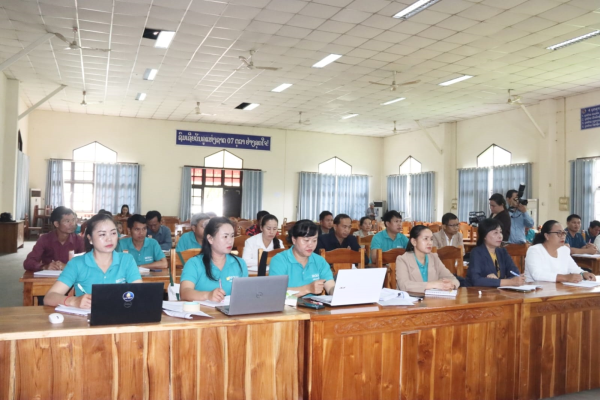
60 participants from Luang Namtha and Luang Prabang TTCs, PESS of Luang Namtha, Phongsaly and Bokeo joined the 5 days training of trainers.
Each year, the IPS teams are reviewed and updated to replace staff who retire, go on maternity leave, or step down, ensuring districts retain the support they need. Following a review in April 2026, the teams now include 1,124 IPS staff, of whom 53% are women and 54% are from ethnic backgrounds. These experienced teachers and principals will receive training at the district level in July and August before continuing their support to teachers in their local areas throughout the 2026–27 school year.
The seventh Training of Trainers workshop focuses heavily on practical support for teachers. Participants will learn how to adapt lessons for multigrade classrooms, promote gender-responsive teaching, support students with disabilities, and use the Teacher Self-Assessment tool to guide professional development.
Ms Nuanchan explained that the workshop is designed to be hands-on and directly relevant to classroom realities participants will work on real examples, develop multigrade lesson plans, and practise with tools they can use with teachers. The sessions are collaborative and practical, so IPS staff can take these ideas back to their districts and put them into action.
This year, the workshop also includes activities on gender and social norms, helping IPS staff reflect on how attitudes and beliefs can affect participation and learning. In the disability inclusion sessions, participants will explore ways to better identify learning needs and support children so they can take part more fully in class.
"When teachers feel supported, valued, and equipped to handle real classroom challenges, they are better able to help every child learn and succeed. Stronger teaching support is not only good for schools, but also for the country’s long-term development. By strengthening basic education, we are helping build the foundations for Lao PDR’s future human capital. When teachers are supported, students learn better, and that builds a strong foundation for economic growth," Mr Currie concluded.