
MoES and Australia Begin Work on Gender-Equitable Management Tool

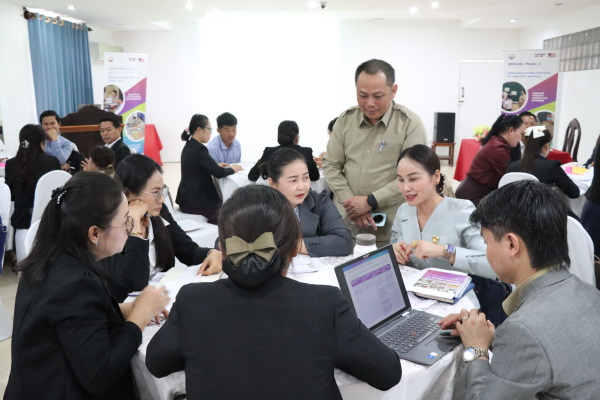
Participants reflecting on behaviours and social norms in educational institutions and workplaces.
Mr. Phimmasone Sisaath, Deputy Head of the MoES Cabinet Office, chaired the first of three technical workshops to design the GEM tool under the leadership of the Division for the Advancement of Women, Mother and Child (MDAW). The workshop brought together more than 60 participants from central and subnational levels, including Committees for the Advancement of Women, Mothers and Children, Provincial Education and Sports Services (PESS), District Education and Sports Bureaus (DESB), Teacher Training Colleges (TTCs), and BEQUAL experts.
Mr. Phimmasone Sisaath explained the purpose of the tool: “MDAW identified the need for a simple, practical instrument to transform workplace culture in education, science and sports. The GEM tool will help MoES departments, TTCs, PESS and DESBs assess their practices, develop action plans, and remove barriers to women’s participation in leadership. I thank Australia for supporting this work and welcome everyone’s contribution as we begin shaping a practical tool suited to the Lao context to guide workplace culture change across the sector.”
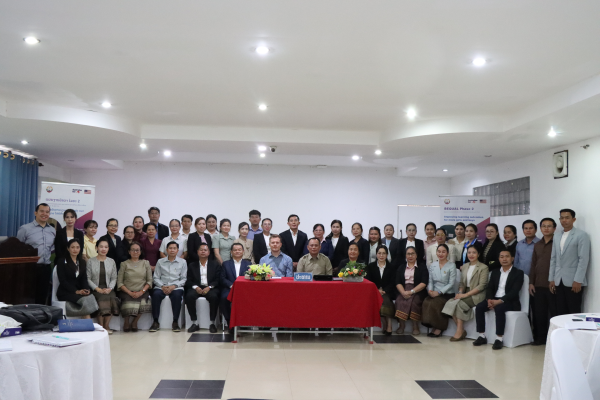
The workshop brought together more than 60 participants from central and subnational levels.
In a separate interview, Mr Michael Currie, First Secretary at the Australian Embassy, shared Australia’s perspective on the partnership and its expected outcomes. “Gender equality is central to Australia and underpins our International Gender Equality Strategy. It helps drive fairer, faster progress for everyone. Greater political and economic participation by women makes societies more prosperous and more peaceful. That is why we are proud to support MoES in developing the GEM tool: to raise awareness of the gender and social norms shaping workplace culture in education and to remove barriers so more women can advance to leadership roles. We share a common commitment to advancing gender equality at all levels.”
Over five days, participants engaged in a series of hands-on activities designed to build their understanding of gender and social norms and translate that knowledge into a practical tool. The workshop opened with analysis of data from surveys with internal pedagogical support staff. Teams reviewed data posters, discussed patterns in small groups, and reflected on what the findings reveal about workplace beliefs and behaviours. An “iceberg” activity then linked visible behaviours—what people say and do—with the deeper attitudes, social norms and assumptions that drive them.
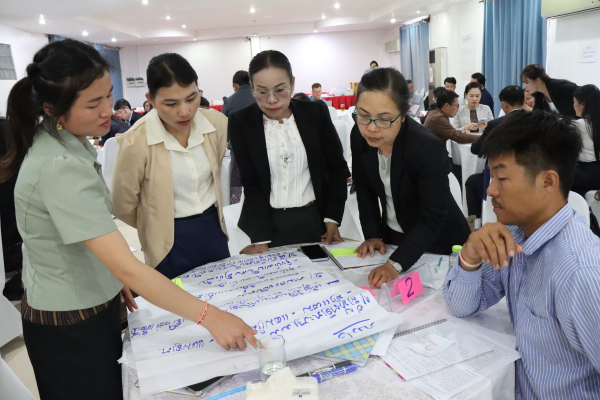 Script writers exploring the 20 questions of the Child Functionning Module.
Participants compared three international gender assessment tools to identify features most suitable for adaptation to the Lao context. Small groups then mapped local social norms, institutional barriers and enabling factors relevant to MoES at both central and subnational levels. The latter half of the workshop focused on collaborative drafting: participants identified the GEM tool’s core domains, proposed indicators, and outlined the overall structure. Participatory approaches, such as a gallery walk, were used to test, refine and reach consensus on the draft structure and indicators, ensuring the tool is practical and grounded in Lao realities.
Mr. Vanmany Vannasy, Head of MDAW, commented: “Next, the Technical Working Group will refine the agreed outline and reconvene for a second workshop at the end of June to develop the first full draft of the GEM tool. BEQUAL and MDAW will continue to facilitate a series of workshops, training sessions, and a pilot phase, with the aim of finalising a pilot-ready tool by December 2026. Following the pilot, the tool will be revised for broader rollout across MoES departments and subnational offices.”
Concluding his opening remarks, Mr. Phimmasone Sisaath said: “As we begin this workshop, I urge everyone to share your views openly, engage constructively and listen carefully. Together we will examine how gender and social norms shape our schools and workplaces, challenge assumptions, and develop practical steps for change. By working collaboratively, I am confident we can create a tool that strengthens leadership, supports teachers, and improves learning outcomes for all students.”
Mr. Michael Currie reiterated Australia’s expectations for impact: “We look forward to the GEM tool driving meaningful change—more inclusive workplace cultures, greater representation of women in leadership, and practical actions that close the gap between policy and practice. Through this partnership with MoES, we hope the tool will be scaled across the system and lead to better opportunities and learning outcomes for all children.”