
Agricultural Support Program Transforms Livelihoods in Nam Mo Village


Ms. Onkham Thannavong
Over the past five years, the assistance has included financial backing, farming inputs, and technical training in modern production methods—most importantly, along with a guaranteed market. Each week, Ms. Onkham now sells vegetables to the company worth approximately 1,700,000 to 1,800,000 kip.
“In the past, we faced many difficulties,” she said. “We grew crops mainly for our own consumption and had no stable buyers. Now, our income is more secure.”
With steady earnings, her family can send their children to school, cover daily expenses, and set aside savings for emergencies. What was once uncertain, seasonal farming has become a dependable livelihood.
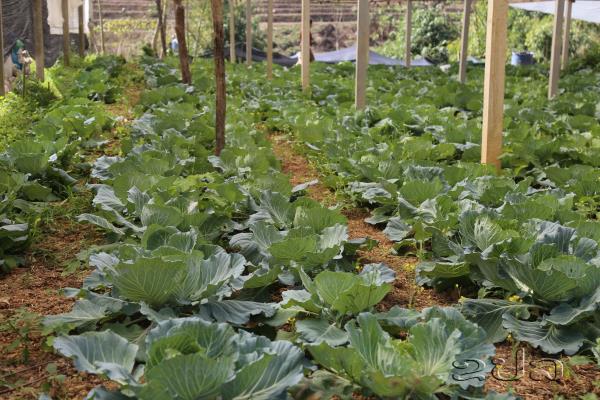
According to Mr. Buasay Lathsakhounthai, Senior Education Project Officer from the company’s Livelihood Sustainability Department, agriculture is one of six key pillars in the company’s broader community development and livelihood security strategy. The program also covers education, public health, infrastructure, village development funds, and strengthening technical capacity within communities.
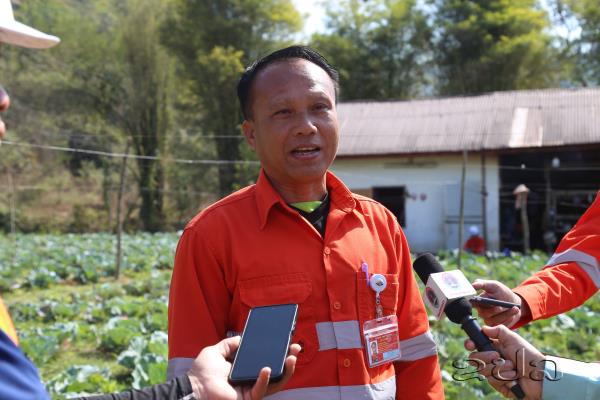
Mr. Buasay Lathsakhounthai, Senior Education Project Officer from the company’s Livelihood Sustainability Department.
“Agriculture is a major focus because it directly improves household incomes,” he said. “We aim to help villagers transition from subsistence farming to commercial production.”
Previously, farming and livestock raising in Nam Mo Village were largely limited to household consumption and lacked organized marketing systems. Today, with support that includes greenhouse construction, improved cultivation techniques, and seeds for crops such as onions, mustard greens, cucumbers, beans, and cabbage, production has increased significantly.
The company not only provides inputs and training but also purchases produce directly from villagers to supply its project kitchens. Surplus products are sold in district markets and other provinces, further expanding income opportunities.

The impact has been tangible. Participation in the program in Nam Mo and neighboring Nam Yon Village has grown from 30–40 households to more than 70 families. Villagers have gained stronger technical knowledge and improved farming skills, contributing to more sustainable production practices.
Most importantly, incomes have risen and living standards have visibly improved. For families like Ms. Onkham’s, the program represents more than agricultural assistance—it offers stability, opportunity, and hope for a better future.
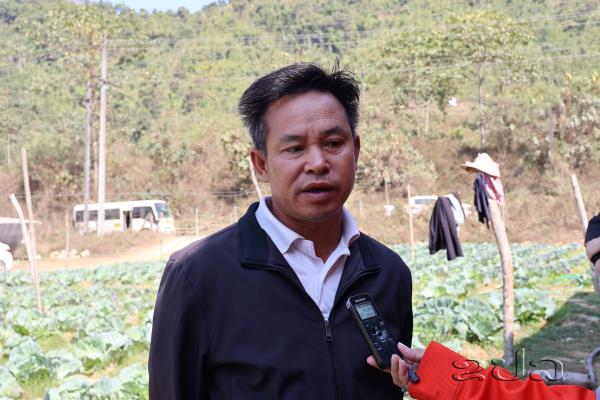
Mr. Khamtou Kouangkai, Head of Nam Mo Village, said the village’s development clearly demonstrates the positive results of cooperation with the private sector, particularly with Phu Bia Mining, which has played a key role in steadily improving local living standards.
In recent years, the company has contributed significantly to infrastructure development in Nam Mo Village, Anouvong District, Xaysomboun Province. These efforts have included constructing and upgrading roads to improve transportation, supporting crop cultivation and building greenhouses, and directly purchasing agricultural produce from villagers. The company has also assisted in constructing a school, a health center, and other community facilities.
At the same time, in his role as a village leader serving as a bridge between the Party-state, the community, and the private sector, Mr. Khamtou highlighted several areas where he hopes the company will continue its support.